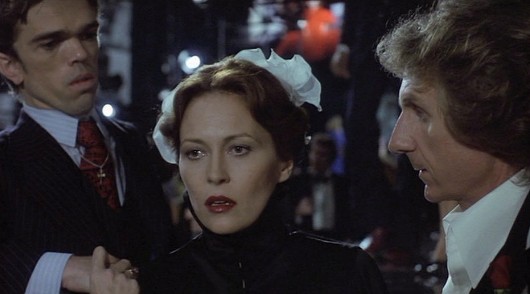
Firstly, let me start off by saying that I needs to get some chicken and waffles down my gizzard toot sweet. I don't know what it is, but I've recently developed a serious hankering for deep fried bird meat and pancake-based breakfast food. Oh, and if that wasn't kooky enough, I've also acquired this sane yet remarkably specific desire to chew on Mary Crosby's thighs (yeah, that's right, the same Mary Crosby who played the scheming Kristin Shepard on Dallas). I'm no addiction specialist, so I can't possible begin to speculate as to why I've become infected by these peculiar afflictions at this particular point in the space-time continuum. However, I did just finish watching Tapeheads, a wonderfully sardonic film that was recommended to me, oh, let's say, four or five million years ago by an astute linguist whose love for The Swanky Modes is legendary, and if there are two things people takeaway from this curious undertaking that repeatedly shuns the unsubstantiated tenants of antiquated verbosity, it's that fried chicken should always be served with waffles, and that Mary Crosby has succulent thighs. Actually, if you think about it–putting aside the waffles for a minute–it seem the items I'm currently obsessed with are both leg-based meals. Of course, one of the items is consumed for real, while the other, depending on the level of your kink, is consumed figuratively. Either way, you gotta love it when a warped theory comes together in a manner that seems truly organic, but in reality, was completely accidental.
 Speaking of which, accidental greatness is what propels a couple of music video directors to great heights in Tapeheads, a film that celebrates, and, at the same time, mocks the music industry with a playful aplomb. Wait a minute, did I just say that it celebrates the music industry? No way, man, if anything, this film, directed by Bill Fishman and produced by Michael Nesmith (Repo Man), mostly mocks it, and it does so in a manner that was spot-on in terms of skewering a subject matter ripe for scornful derision. Record label execs who expect their minions to work for free, mullet-sporting Animotion-wannabes from Sweden, heavy metal fans who abuse the word "awesome" (Zander "there's fuckin' room to move as a fry cook" Schloss plays a headbanger who attends a concert that might feature Menudo, "might" because the marquee says "maybe Menudo"), and right-wing politicians who like to be spanked by women who look like Susan Tyrrell and Courtney Love, all get ridiculed to some agree in this satire of that faraway world that was once dominated by music television.
 Nowadays, I can watch any music video I want, whether it be a scintillating slab of italo disco or an ear-destroying piece of post-industrial sex music. My eyes are never more than a click away from immersing themselves inside the warm, Mediterranean embrace of Sabrina Salerno's gyrating cleavage (in most cases I would have said "thighs," but I'm awfully close to using up my thigh quota for this entry, and I'm only on paragraph three). But back in the late '80s, what came in contact with our eyes and ears was strictly regulated by the reticulated forces of unseen lameness. Think about that, a small group, or, in some cases, a single individual, would dictate what kind of music you could and could not listen to. Put another way, while I was bravely enduring music videos by the likes of Honeymoon Suite and Glass Tiger, classic clips by Fancy and Missing Persons were going completely unmolested by my discerning eye and ear areas.
 Disturbed by the fact that the cultural landscape is being saturated with shoddily produced music videos, two childhood friends who used to work as security guards decide to start their own video company called "Video Aces." Handling the business end of things is Ivan Alexeev (John Cusack), a real go-getter who seems to be channeling Midge Ure circa Vienna, while the more artistic inclined Josh Tager (Tim Robbins) supplies the creativity. Acquiring a spacious studio loft, free of charge, thanks to Belinda (Katy Boyer), a painter with a penchant for volumizing scrunchies and shooting her canvas with the occasional shotgun blast, Ivan lands the fledgling startup a gig directing a commercial for a local fast food restaurant.
 An instant classic the moment Roscoe (King Cotton), the self-assured purveyor of Roscoe's Chicken and Waffles, enters the frame, this particular commercial, despite having a middle-aged white guy rapping at its core, is a smashing success. Sure, Ivan and Josh are paid in chicken and waffles (which apparently are "just pancakes with little squares on 'em"), but sheer scope of the yellow and black world they create, one that features a trio of succinct soul sisters who cross their legs in unison while singing about chicken and waffles, gives them the confidence to seek out bigger clients. Okay, gigs that involve filming séances for recently deceased dogs and the living wills of a bedridden men aren't exactly setting their bank accounts on fire, but it's a start.
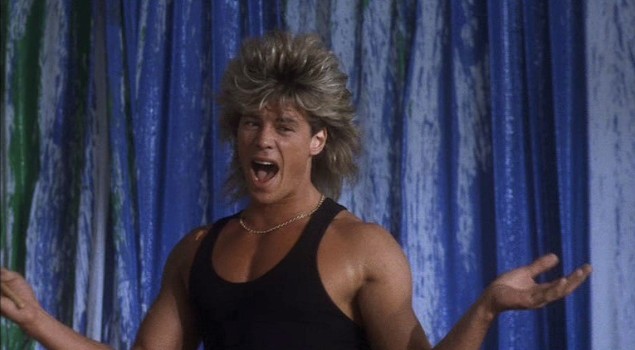 What does a music video made on "spec" look like exactly? Well, it kinda looks like three Swedes trying to play synthesizers while having buckets of house paint dumped on their mullet-covered heads (glitter, feathers, fireworks, and water from a fire hose come later). Hired by the dapper Moe Fuzz (Don Cornelius), CEO of Fuzzball Records, the Video Aces land a plum job directing a music video for "Baby Doll," the new single by Cube-Squared (which, in reality, is a DEVO song). Unfortunately, they're working on spec, which means they're not getting paid (not even in chicken and waffles), and, to make matters worse, the video they submitted, according to Mr. Fuzz, "lacks production value" (in other words, no "tits and ass").
 Frustrated by their inability to catch a break, the music industry is a fickle hosebeast, Ivan and John decide to apply some "shrewd market penetration," and find themselves at an upscale party hosted by Norman Mart (Clu Gulager), a well-hung presidential hopeful ("I'll put my slab on the yard stick against Gorby any day," he boasts at a press conference) and his garishly dressed wife, Kay Mart (the fabulous Jessica Walter). There to videotape the limbo themed festivities, the Video Aces get unintentionally sucked into a botched blackmail scheme conceived by Nikki Morton (Susan Tyrrell), Norman's excitable mistress (you have to admire a guy who employs Susan Tyrrell as his go-to deviant). The mildly depraved politician (he likes to ride Miss Tyrrell while wearing in a pink tutu) looses track of a videotape containing a previous session of perverted madness, so he orders his team of special agents to find it.
 Of course, the tape ends up in the possession of the Video Aces. But more importantly, Ivan gets to massage the exquisite thighs attached to the sultry frame belonging to Samantha Gregory (the gorgeous Mary Crosby), a rock journalist/foxy babe/no-nonsense business woman. Just a second, why is he massaging her thighs? Covered in a maze of thigh-accentuating laces, Samantha's tight-fitting, burgundy dress is being felt up by Ivan because he was looking for a missing contact lens. Duh, squared. Anyway, impressed by his hands on approach to finding her missing contact, his obsession with money and success, and, of course, his overall Midge Ure circa Vienna vibe, Samantha decides that she wants to exploit Ivan for her own personal gain (that's people did in the '80s).
 Since new wave and white rap has already been properly mocked, it's time for Tapeheads to ridicule the pomposity of heavy metal, and who better to encapsulate that pomposity than Stiv Bators as the leader a band called The Blender Children. Now you'd think I'd dig this scene because it features scantily clad women jumping into a giant blender, but I actually preferred Xander Berkley's use of the c-word and the fact that one of the blender bimbos asks Tim Robbins to teach her how to read. Oh, and keeping you abreast of Mary Crosby's wardrobe (designed by Elizabeth McBride): she wears a black leather dress with a matching pair of gloves during this sequence.
 My favourite scene was the one where Samantha, nunchucks/black leather, and Belinda, duel butterfly knives/red pajamas, engage in a battle for the very soul of the Video Aces. You could say that their fight represented the overall temperament of the 1980s: Samantha, who craves fame and worships material wealth, vs. Belinda, who's all about artistic integrity and neon scrunchies. Well, whatever it represented, nothing beats the sight of Mary Crosby wielding nunchucks.
 "You look ravishing and I'd like to chew on your thighs." And with that forthright utterance, John Cusack's Ivan Alexeev jumps to the top of my list of beloved movie characters. Akin to Craig Wasson's panty rescue in Body Double, Ivan's compliment with cannibalistic overtones to Samantha while they dined together at a seafood restaurant was the sanest thing I've heard uttered in a motion picture in a long time. Making matters even more awesome, he also tells her that he wants to flambe her flesh with his tongue. (I'm telling you, I love this guy!) These are the kind of thoughts that rattle around inside my head while I'm riding the subway, and to see someone in a movie actually verbalize these thoughts was mind-blowing.
 If things couldn't get any better, after dinner (don't judge me to harshly, but I made an actual laughing sound when John Cusack mistakenly took a sip from a candle), Ivan and Samantha head over to the local cemetery, where he inspects the tightness of her red and black lingerie with a probing beam of light (a.k.a. a flashlight).
 Accidentally recording the audio from The Blender Children video shoot onto a tape containing black and white footage of a funeral they shot recently, Ivan and Josh are shocked to learn that their apparent fuck up is being hailed as a work of post modern genius (a critic played by John Fleck declares it so at a viewing party) after it airs on RVTV (the luminous Martha Quinn introduces the clip). And just like that, Video Aces become the darlings of the music video world. However, unlike most inadvertently successful people during the 1980s, Ivan and Josh, well, Josh, anyway, are determined to use their new-found success for good instead of evil. This goodness manifests itself when they decide to help resurrect the career of The Swanky Modes (Sam Moore and Junior Walker), a washed up singing duo that Ivan and Josh have been huge fans of since they were kids.
 The plan is to commandeer a Menudo benefit concert (one that is being shown around the world via the miracle that is satellite television) by inserting The Swanky Modes onto the bill instead. Of course, things don't quite work the way Ivan and Josh had originally planned (don't forget, Norman Mart's merry band of incompetent henchman are still looking for the missing videotape), but in the end, after Samantha is finished dodging shrapnel (kudos to Mary Crosby for doing her own stunts), The Swanky Modes take the stage and rock the house with a stirring rendition of "Ordinary Man." The End. Oh, and the word "waffle" is paired with "unlawful" during Roscoe's closing credits rap.
video uploaded by Darryl347
...