Showing posts with label Franca Stoppi. Show all posts

Sunday, July 14, 2013

The Other Hell (Bruno Mattei, 1981)

I'm not a big fan of nuns. And I'm certainly not a fan of nunsploitation movies. This dislike, by the way, has nothing to do with some sort of traumatic experience I had as a child/sticky-fingered miscreant. Beyond the fact that nuns were used in the ads for a chain of dry cleaning joints, Sketchley Cleaners, I haven't had much experience with nuns. Wait, I think Sketchley Cleaners used penguins in their ads. What I think I meant to say was Cadet Cleaners. Great, now I'm confused. At any rate, I just don't like their  whole holier-than-thou attitude. Just kidding, I could careless about that. No, what I'm not a fan of is their outfits; they're not sexy. Aren't you a little bit curious about what's going on underneath all those thick layers of pious fabric? Hell no. However, if you were to put say, the luminous Franca Stoppi (Beyond the Darkness) in a nun's habit, and have her appear in a convent-set film written by Claudio Fragasso and directed by Bruno Mattei (Hell of the Living Dead), then I might have a change of heart. Don't tell me, there's a film floating around out there that just happens to adhere to the frightfully specific standards I just finished laying out? Hot dog! And what's this? I'm being told that I just watched it. Woo-hoo! It's called The Other Hell (L'altro Inferno), and, of course, it sort of sucks ass, but it's also kind of great, too. And that, in one of them nutshell thingies, is the main reason I will continue to beat myself over the head with Bruno Mattei cinema. You could say I enjoy the mind-altering headache that inevitably comes after I have inflicted a Bruno Mattei movie on myself. At first, you'll notice that it stings a little bit. But after a while, you get used it. So much so, you'll be wishing that every movie was directed by Bruno Mattei, a.k.a. Stefan Oblowsky. Oh, and don't forget Claudio Fragasso; yeah, he should definitely write every movie.
 
 
A cautionary tale about what might happen if you inexplicably decided to put Franca Stoppi's demon baby in a pot of scalding hot water, The Other Hell is possession, murder and forbidden lust wrapped in an exhaustively precise package. It is? Oh, it totally is. And get this, Franca Stoppi's face is always framed by her black and white nun head covering. Hold on, head covering? There must be a better name for it than that. How about headpiece? Headpiece. Headpiece. It's better than head covering, I'll give you that. But I need something with a little more pizazz. I think I got it. Are you sitting down? Yeah, yeah, what is it already? Wimple. Let it sink in. Wimple. You know what? I like it.
 
 
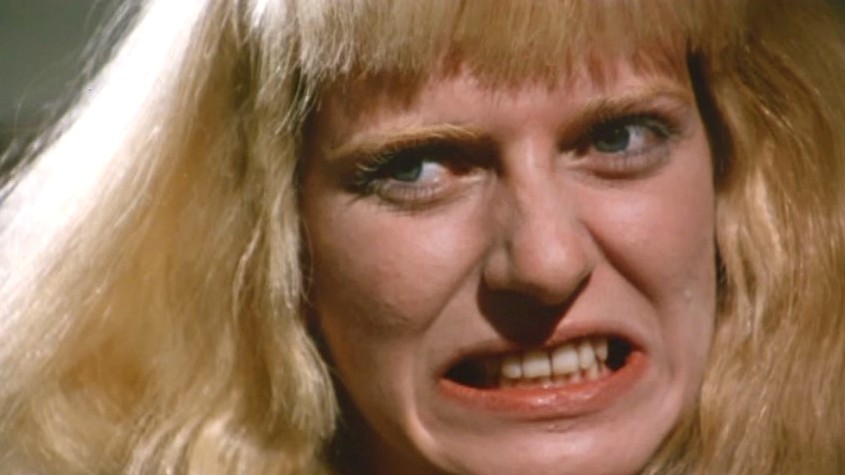
I'm gonna give the whole face framing thing another go, as I would like to use the word "wimple" in a more organic-sounding fashion. Shot from every angle possible, Franca Stoppi's beguiling mug is always framed by her wimple, a medieval piece of clothing that covers the head, as well as the neck.

 
I can't stress this enough: The wimple is the perfect garment for an actress like Franca Stoppi, as it accentuates her strongest feature. And that is, of course, her gorgeous face.
 
 
Don't get too excited my fellow Franca Stoppi fans. In order to see our beloved Franca Stoppi glower from the inside of a nun's habit, you're going to have to watch The Other Hell. Well, duh, we kind of figured that out already. No, I don't think you understand. You're going to have to watch this movie. Hmm, when you put it that way, it doesn't sound so easy.
 
 
Never fear, Goblin is here. It's true, the Goblin music heard throughout The Other Hell is simply the score from Beyond the Darkness. Nonetheless, it was comforting to hear their unique brand of synth-rock every now and then, as it perked up the film's many dull patches.
 
 
"The genitals are the door to evil!" You can say that again, sister. Notice how she said they were "the" door and not "a" door. Mildly fascinating. Down below in the convent's basement laboratory/crypt, one nun, let's call her Sister Assunta (Paola Montenero), is telling another nun about the wickedness that lies beyond the labia. And just as she's wrapping up her anti-pussy diatribe, a set of glowing red eyes appear from out of the darkness. These eyes, of course, cause Sister Assunta to stab the other nun to death.
 
 
If what I just described sounds out of the ordinary for a nunnery, I have to say, it's pretty standard stuff for the convent that's run by Mother Vincenza (Franca Stoppi), as acts of nun-on-nun violence are par for the course at this place.
 
 
Don't believe me? Just ask Boris (Franco Garofalo), the convent's resident creepy gardener. If he sees a nun ranting and raving about the devil while bleeding from the mouth, he will simply shrug his shoulders and continue trimming the bushes.
 
 
While Mother Vincenza and Boris the gardener (he also runs the dog pound/chicken farm next-door) seem indifferent to the convent chaos, the members of the clergy seem to think otherwise. When the doltish Father Inardo (Andrea Aureli) is unable to get to bottom of things (his attempt to pray the evil away is met with mixed results, and by "mixed results," I mean it was met with complete and utter failure), the church sends in Father Valerio (Carlo De Mejo), a sort of  ecclesiastical detective who solves problems by using reason and logic.
 
 
As he arrives, Mother Vincenza is forcing the other nuns to burn all of Sister Assunta's things; he's also nearly mauled by one of Boris' dogs. So, right from the get-go, it's clear that they have something to hide. But what could it be? Frankly, I don't really care what they're hiding, as the film is not providing me with anything I can use from a perversion perspective. Oh, you poor thing. Is this nun-based supernatural thriller lacking in the titillation department? Yes. Yes it is. Well, suck it up, and stop being such a baby. Not every film is going to cater to your debased needs. Why not? The world doesn't work that way. What you should have done was not watch the film. Now you tell me.  
 
 
That being said, I did like the hanging dolls. Hanging dolls? Yeah, the attic was filled with naked dolls hanging from the rafters. If you add the music of Goblin to the sight of the dolls dangling, it creates a pretty effective sense of dread. You know what? You're right. The sight of the dolls dangling to the music of Goblin is pretty dread-inducing.
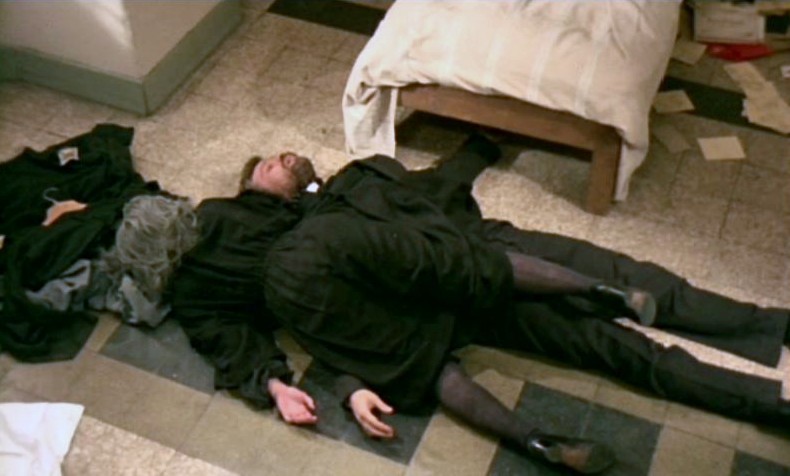
 
 
And as far as perversion goes, check out the scene where a prematurely grey nun (Susan Forget) chokes Father Valerio in her room. No offense, but I'm not really into strangulation. No, pay attention to the part where she collapses on top of him mid-choke. What am I looking for? Look at her legs. Oh, they're sheathed in black nylons. Nice. I'm glad you pointed them out, because I was just about to declare The Other Hell a nylon-free zone.
 
 
You know what else needs pointing out? What? The fact that the guy dubbing Carlo De Mejo's voice sounded exactly like Dean Learner from Garth Marenghi's Darkplace. Are you serious? I'm deadly serious. Wow, this little nugget of information just upgraded The Other Hell from lame to not-so lame.
 
 
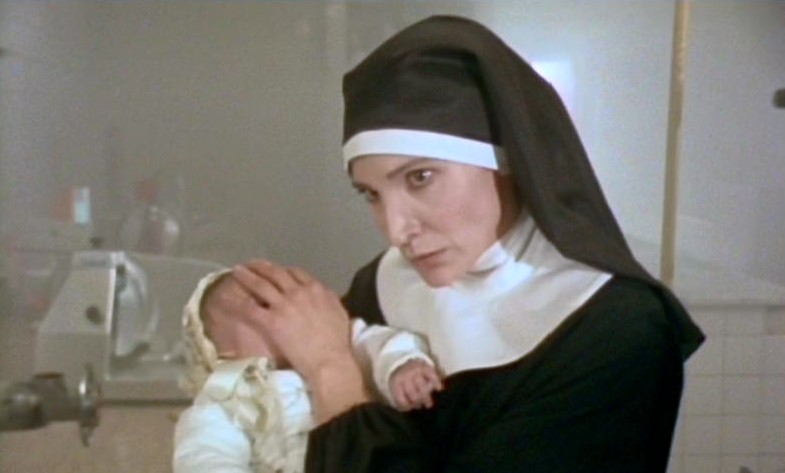
What about Franca Stoppi? What about her? She must do something besides look delightfully sinister in her habit? Let me see. Oh, yeah. There's this flashback sequence that has Franca Stoppi employ one of the most trouser-moistening head turns while holding a recently scalded baby in recent memory. Imagine being on the receiving end of one of Franca Stoppi's trademark head turns, I would do more than just pee my pants (too much information?). It should go without saying, but the synth flourish that accompanies Franca Stoppi's head turn was awesome. As was the part where Franca Stoppi tells Father Valerio that men only emit empty screams when they're stabbed, yet when women are stabbed, they produce children. I couldn't have said it better myself; pure poetry.
 
 
Ending like you would expect (with lot's of nuns screaming), The Other Hell will probably be my last nunsploitation film for quite some time (what can I say? the genre is not habit forming). I'm not giving up on the genre entirely, but I am going to be a lot more careful when it comes time to choose my next foray.


video uploaded by micarone

Sunday, October 16, 2011

Women's Prison Massacre (Bruno Mattei, 1983)

Yeah, well, I think you're wrong. Dead wrong, in fact. If you look closely, you'll notice the stay-up stockings worn by all the female prisoners are dark charcoal grey, and not, as you have so erroneously pointed out, black. It's true, the colour of the band near the top of the stay-up stockings are close to being black, but as for the rest of the stay-up stockings, they're dark charcoal grey. The warden's garter belt-assisted stockings, on the other hand, are definitely black. Oh, hello, it would seem that you have accidentally stumbled upon an argument... uh, I don't know if I'd call it an "argument," let's just say it's a "heated discussion." Okay, it would seem that you have accidentally stumbled upon the middle of a heated discussion I was having with myself over the colour of the prison issue stockings worn by the inmates throughout Women's Prison Massacre, Bruno Mattei's sleazy ode to albino enchantresses, girl-on-girl everything, weaponized vaginas, pithy putdowns, and, of course, women who happen to be in prison. You see, while I think they're dark charcoal grey, the other half of my brain (the half who likes to stay up all night watching reruns of The Nanny, a program awash with imagery that promotes a world where black is dominate shade of hosiery) thinks they're black. Oh, and just because I'm using the term "dark" does not necessarily mean that part me of secretly thinks they're black, they're just dark in terms of the grey spectrum. In all honestly, I have this sneaking suspicion that the part of me who thinks the stay-up stockings are black is just messing with me. They know the stockings weren't black, they just like to see me make a fool out of myself in front of all you good people over something as trivial as stockings. You see what they just did? They made me use the words "trivial" and "stockings" in the same sentence. Talk about an exacerbated pickle drowning in a tepid pool of unsubstantiated pandemonium. Here's some free advice: In the future, try to be a little more cautious whenever you get the temptation to pretend that you have some sort of split personality disorder, as the odds of saying something you might regret are quite high.

Okay, now that we've finally established the colour of film's signature legwear, let us move on to less pressing matters. The film opens with a shot of three women sitting on a darkened stage, as somber piano music plays on the soundtrack. Soon, the somber piano music is accompanied by cold synths, warm synths, and, my personal fave, eerie synths. Wait a second, what's going on here? This has got to be the strangest opening to a women in prison flick that I have ever seen. But you know what? I like it. And it gets better. Appearing out of the darkness, her face painted like Jordan from Jubilee, the first woman we're introduced to is Laura (Maria Romano), who is wearing what she likes to call her "snake mask." Describing herself as a praying mantis, Laura's monologue mostly revolves around emasculating men. The large breasted middle child of the prison soliloquy set, Irene (Antonella Giacomini) is up next. Calling herself "Irene, the slut," she goes on and one about how she's a "pleasure spring" (all the men want to drink from her shapely fountain). Rounding out this pokey production of the Vagina Monologues is Emanuelle (Laura Gemser), whose her lecture is all about love and freedom.

While she's prattling on about human rights, a mane of blonde hair can be seen piercing the sooty air like an iridescent bolt of lightning. Who do these golden locks belong to, you ask? Why they belong to Albina (Ursula Flores), a.k.a. the most beautiful human being to walk the face of the earth. Oozing gorgeousness with every sultry step, Albina, annoyed, and rightfully so, by the so-called "art" that she and the audience (a ragtag collection of inmates and guards) have been enduring for the past ten or so minutes, walks up to the stage and expresses her displeasure by calling their play "revolting," and by hurling a fist full of tomatoes in the general direction of Emanuelle's smug face.

After the tomatoes hit her in the face, Emanuelle jumps into the crowd and starts to wrestle with Albina (more veggies are hurled, more feelings are hurt). We might not know it yet, but what we are currently watching is the genesis of one of the greatest rivalries in the history of cinema. The first round of the Emanuelle-Albina conflict is a draw, as the guards break them up just as they were about to start pummeling one another. But if Albina's post-fight rantings are any indication, the war between them is far from over. The blondness of Albina's concise eyebrows vs. Emanuelle's chocolaty cheekbones is the primary plot line of Women's Prison Massacre. Oh, sure, it wants you to think the hostage situation involving a hirsute lawman and four deranged male convicts is the film's nitty-gritty in terms of nutritional value. But make no mistake, the fight for female supremacy that takes place between Emanuelle and Albina is definitely the main course.

If it seemed odd that the warden (Lorraine De Selle) appeared to take Albina's side when it came time to lay blame for veggie vagina altercation. Well, that's because Albina is in the warden's pocket. Yeah, you heard correctly, Albina takes her orders directly from the warden. But why does the warden want to make Emanuelle's stay at her prison so uncomfortable? Who cares, because round two of Emanuelle and Albina's epic struggle is about to commence.

Entering the cafeteria with a disquieting elan, Albina saunters over to where Emanuelle and her pals, Laura and Irene, are sitting and proceeds to antagonize the living fuck out of them. Mocking Irene's slut monologue, Albina basically calls her a "stupid bitch." When Laura tries to stick up for her friend, Albina quickly interjects by telling her to "take my advice and die." Unmoved by her morbidity of her suggestion, Laura threatens to bite Albina's nipples off (if anyone is going to gnaw on Albina's luscious nipples, it's going to be me, so back off, Laura). Shifting her attention to Emanuelle, Albina calls her "fancy talker," which she objects to by saying, "don't call me fancy talker." As you can plainly see, the dialogue in this particular scene is off the charts in terms of inventiveness. However, in my mind, it achieves legend status the moment the phrase "haughty hottentot" leaves Albina's chapped lips. Even as the alliterative put-down was in the process of being uttered, I knew I was in the presence of greatness.

Anyway, unfazed by the fact that she was called a "haughty hottentot," Emanuelle tells her pigment-deficient tormentor that she makes her sick. Well, after some mild maniacal laughter and some boastful statements pertaining to her strength, Albina finally reacts by challenging Emanuelle to an arm wrestling duel. The bout goes back and forth for quite some time, but, ultimately, Emanuelle comes out on top, which is weird, considering she has pipe cleaners for arms.

You'll notice as the two rivals are arm wrestling that two guards are watching over them. Which isn't that uncommon. After all, most prisons have guards. No, what you need to focus on is the fact that the guards are being played by none other than Franca Stoppi (Beyond the Darkness) and Françoise Perrot, two actresses who bring a certain butchy flair to their respective roles. The beguiling Miss Stoppi, in particular, as every time the camera would focus on her wonderfully crafted mug, I would start to hyperventilate. My favourite Stoppi/Perrot moment was when they're forcing Emanuelle to wash her face. While that doesn't sound all that bad, the catch is that she has to keep her face submerged in a sink full of water until they tell her to remove it. What I liked about this scene was that Franca and Françoise would exchange these sinister smirks with one another in-between beatings (every time Emanuelle pulled her head out of the sink, they would hit her with their clubs), as it implied that they enjoyed their work and each others company.

Staying within the dank confines of the women's lavatory, a naked Laura and an almost naked Irene (the way her skimpy white panties struggled to maintain their structural integrity as they desperately clung to her curvy frame was simply divine) can be seen making out with each other. When Albina's sidekick catches wind of this tawdry display, she immediately informs her pale master about the sapphic transgression that is transpiring within their midst. After staring at them with fake disgust for a few minutes, Albina gathers a crowd around them, which alerts the guards. Telling them that these "dogs in heat need to be cooled down," Franca and Françoise start dunking their heads in cold water. Keep an eye on Albina as they're being severely punished, her aura is steeped in gladness. And if Albina's happy, I'm happy.

Recovering from her own dunking incident (simulated drowning seems to be the preferred punishment at this particular prison), Emanuelle is surprised when Albina enters and offers to help her to her feet. This kindness doesn't last long, however, as right after she says, "fancy seeing you here, fancy talker" she hits her in the face with a towel. Uh-oh, a towel to the face? That can only mean one thing: it's time for round three, baby! As is customary in the realm of cellbock fisticuffs that involve women, Emanuelle grabs Albina's hair, only to find out that her bleached adversary is wearing a wig. Holding the wig in her hand, Emanuelle starts to laugh at Albina. This, of course, angers her immensely, and she attacks Emmanuelle, not before calling her a bastard and telling her how much she hates her (I think the exact line was, "You bastard! I hate you!").

Oh, man, Emanuelle is thrashing Albina with own wig! What the fuck? When is this humiliation going to end? Growing up pale and different, Albina has struggled to fit in her entire life. Picked on at school and ridiculed by the customers at the flower shop she probably worked at, Albina swore that she would one day get back at all those who made her life a living hell. She didn't realize it immediately, but being sent to prison was the best thing to happen to her, as her unique appearance and unpleasant disposition intimidated the other inmates. Eventually becoming the de facto ruler of the prison, thanks, in part, to her brash attitude and her willingness to snitch on others, Albina had it made. That is, until some fancy talking haughty hottentot came along and ruined everything.

Do I even have to tell you who wins round four? Well, if must know, round four takes place out in the prison's yard, and involves the guards leaving Emanulle all alone to face Albina, who's been given a switchblade. "Hello, fancy talker," she coos, as she makes her way across the yard's lush green grass (the gal sure knows how to make an entrance). If we were told to judge their various clashes based solely on the quality of the pre-fight bravado, I think most insane people would agree that Albina, hands down, wins them all. Only problem is, Albina can't seem to build up any momentum after her early successes, as her blemish-free bombast usually gets its exquisite ass lambasted in a matter seconds. And the outcome of her well-executed, yet ultimately doomed, screaming knife charge is no different.

Running toward Emanuelle, her knife raised, and screaming her head off, Albina tries to stab her, but instead, she ends up dropping her knife. As she's being choked by her wiry opponent, Albina must be thinking to herself: Why is this happening to me? I mean, I had a knife, I called her "fancy talker," what do I have to do to kill this insipid hosebeast? As they wrestle over the ownership of the dropped knife, Albina's dark charcoal grey stockings are becoming soiled with difficult to remove grass stains. Discerning perverts and chichi linguists alike will want to pay close attention to what happens next, as we catch a brief glimpse of Albina's white panties during this sequence. In fact, the intensity of the tussle has caused them to become partially ensnared between the colourless cheeks that make up the bulk of her creamy buttocks. However, laundry headaches and unforeseen wedgies are the least of Albina's problems, as she soon finds herself with a knife in her right thigh. And not just any knife, her knife.

I won't lie, the sight of Albina screaming in agony as a result being stabbed in the right thigh with own knife filled me with a shitload of sadness. It got to a point where I was so distraught, that I almost switched the movie off in a fit of misguided wretchedness. You know how I said that when Albina's happy, I'm happy? Well, when Albina's in pain, I'm in pain. Just the mere thought of her torn dark charcoal grey stockings languishing unloved in some dank prison laundry room is enough to put me on twenty-four hour suicide watch.

In a veiled attempt to placate my misery, I'm gonna start talking about Crazy Boy Henderson (Gabriele Tinti), Victor "Geronimo" Brain (Raul Cabrera), Helmut "Blade" von Bauer (Pierangelo Pozzato), Brett O'Hara (Robert Mura), because one of them treats Albina like the goddess she truly is. Oh, and, just to let you know, the four guys I just mentioned are convicted murders who take over the women's prison after they overpower the warden, kill a guard, and wound a police officer (Carlo De Mejo) with a beard during what was supposed to be a routine prison transfer.

Free to roam the prison, the four psychopaths (they're apparently the worst of the worst) wander the halls in search of inexpensive poontang. Since the hyperactive "Blade" likes to be groped en masse, he heads to straight for the cells and lets a throng of female prisoners paw at him through the bars; O'Hara makes Lorraine De Selle strip down to her black lingerie; Crazy Boy rapes Emanuelle against a wall; and Geronimo has decided to go to the prison's infirmary to look for drugs. What does Geronimo find when he finally gets there? Heaven on a stale cracker, that's what. Recuperating from her most recent stab wound (her right thigh is wrapped with a modest bandage), Albina stares inquisitively at the strange man poking around her room. "Where's the morphine"? he asks. "How should I know," she quickly shoots back (it's nice to know that the knife wound hasn't put a damper on her scrappiness). As he's looking, he suddenly realizes the woman lying before him, her ashen legs peeking out from underneath the sheets ever so slightly, isn't your average female prisoner.

Caressing her delicate shoulders ("your skin is exciting"), Geronimo tells Albina that everything about her turns him on. When he said that I was like, finally, someone who gets the irregular allure that is Albina. You haven't experienced real pleasure unless you've felt Albina's strong-willed heartbeat pounding against yours as she penetrates you with her soft, elegant flesh. Yeah, that's right. You don't penetrate Albina. On the contrary, Albina penetrates you. And that's exactly what happens to Geronimo, who, from now on, will be known as "the luckiest man in the entire universe." Of course, he ends up treating Albina like crap when she emerges from her chloroform-induced slumber (her supple, bee-stung lips are even more chapped than they were before). When she tries to make a deal with Crazy Boy, the luckiest man in the entire universe acts like her doesn't know her. It's gets to the point where he even allows his esteemed colleagues to call her names like, "Snow White" and "Dracula's Daughter." I know, what a little bastard.

While actress Ursula Flores, the actual owner of the aforementioned "soft, elegant flesh," deserves a lot of the credit for creating such a memorable character (the eye bulging and head tilting alone was award worthy), you shouldn't discount the work of dubbing artist Carolyn De Fonseca (The Lonely Lady), who's the voice of Albina in the English language version of Women's Prison Massacre. If it wasn't for her, lines like, "Take my advice and die!" and "I'll put a stop to your arrogance, you haughty hottentot!" would probably not have had the same impact. Anyway, I hope my you found my covert tribute to Albina to be informative and junk. I'd go into detail about the Russian roulette scene that takes place near the end of the film (round four), but just thinking about it makes this fancy talker extremely depressed.


video uploaded by saintbuff
...

Monday, August 2, 2010

Beyond the Darkness (Joe D'Amato, 1979)

Which is better? To be in a relationship with someone who walks around, talks, and occasionally turns their head to look at stuff, or to be in one with a person who doesn't walk around, nary says a word, and seems to be always looking in the same direction? Personally, I like the talking, but I could do without the episodic neck usage. I want to be with someone who is fully committed to the wonders of voluntary neck movement (the best way to see objects that are on either side of you is to turn your neck). Nevertheless, my opinion on such matters have no baring on what the creep in Beyond the Darkness (a.k.a. Buio Omega) thinks about the question, as his approach to human relationships is a tad on the wonky side. Even when held up against the most eccentric of miscreants. Little things like the inability to carry out any of the everyday functions I just listed are not gonna stop him from spending the rest of his life with the blonde woman of his dreams. It should be pointed out that this abnormal little fella is living with a woman who is, well, living. But thanks to the dizzying power of love, he can't seem to be able to distinguish between what is alive and what is dead.

A veiled examination on letting go, director Joe D'Amato (Erotic Nights of the Living Dead) and his crack team of writers, Ottavio Fabbri and Giacomo Guerrini, explore the perverted depths of a young taxidermist in the midst of a relationship crisis. Unwilling to except the passing of Anna Völkl (Cinzia Monreale), his equally youthful girlfriend, Frank Wyler (Kieran Canter) decides to dig up her recently buried body and bring it home with him.

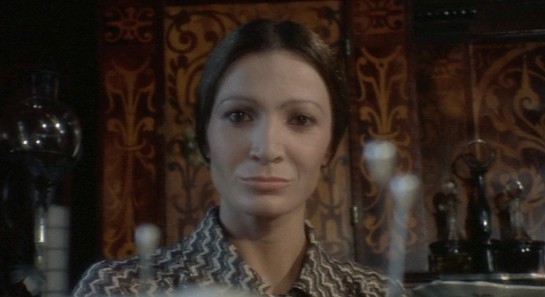
Removing the organs and other such gooey items, Frank, with the help of Iris (Franca Stoppi), a "friend of the family," dresses up Anna and puts her in bed. And since her eyes have been replaced with an artificial pair, Anna's expression now has a piercing, almost cognizant quality about it.

While driving home with Anna's body in the back of his red van, Frank is confronted by an aggressive British hitchhiker (a fresh-faced Lucia D'Elia). Pushy and somewhat obnoxious, this dope smoking free spirit has no idea what sort of weirdo she has gotten herself mixed up with. However, to be fair to Frank, it was the hitchhiker who thrust herself into his bizarre world. I mean, he was merely trying to get the corpse of his dead girlfriend back to his basement workshop before she started to decompose.

On the other hand, Frank's impromptu decision to remove all the fingernails from the curvaceous hitchhiker's right hand with a pair of pliers was extreme and totally uncool. In his warped mind, suffocating her with a dirty rag wasn't enough in terms of savagery, no, she needed something extra. As expected, this brutal act causes the audience to look at Frank in a whole new light. In that, before the fingernail episode, he was just a troubled kid with deceased girlfriend issues. But afterward, well, let's just say, the words "sick" and "twisted" would be used a lot to describe our feelings toward him.

The sheer agony of the pliers scene and the forthright thudding sound Anna's entrails made as the hit the bottom of a strategically placed metal bucket were a jarring introduction to the degree of violence on display in Beyond the Darkness; particularly the guts, which were so real looking. Luckily, or unluckily, depending on your sadism level, the gore reaches its icky plateau during this repulsive sequence of events.

All the same, the wonderfully ample frame of the hitchhiker does need to be disposed of. Which leads us to my favourite event in the entire film, and that is: the hitchhiker dismemberment scene. Of course, I don't like it because it's vile, disgusting and full of hypnotic jiggling, I like how it perfectly captures the bittersweet essence of the peculiar bond that Iris and Frank share in this movie.

The meaningful look Iris throws Frank each time she lifted the meat cleaver before hacking at one of the hitchhiker's well-nourished limbs was quite telling. She was basically trying to convey to him: "Look at what I'm willing to do for you. Forget about your dead girlfriend, Frank, and love me." But you could totally tell that Frank doesn't appreciate her. The blank look on his face as he filled the bathtub with acid spoke volumes.

I couldn't help but notice that every women Frank comes across, whether it be the talkative hitchhiker, the overly dressed disco dancer (Simonetta Allodi) or the clumsy jogger (Anna Cardini), seemed to be way more active than the inanimate Anna. It's obvious that his courting skills are well honed. Case in point: the clumsy jogger was simply enticed by the way he gingerly applied ointment to her swollen ankle, and the disco gal, well, all he needed to do to seal the deal with her was say, "wanna go for a ride," and the next thing you know, she was lathering up her perky breasts in the same bathtub he dissolves hitchhikers in. It's just that he can't seem to take what wooing gains he has made and expand upon them.

Even though he's a frictional character, I've got some advice for Frank. When the attractive jogging enthusiast in red shorts with white trim your about to penetrate starts screaming when she has discovers that there's a dead woman lying in the other bed, don't bite a chunk out of her neck. Not only will she not appreciate being bitten, it will ruin the romantic ambiance. The next time this happens, just take a deep breath and explain to her, in, of course, a clam and reasonable fashion (all the while making sure to resist the temptation to eat their skin), that you like to keep the body of your dead girlfriend around the house–you know, for recreational purposes. It can't fail.

Coming close to encapsulating feminine perfection, Franca Stoppi is beguiling, effervescent, and mildly deranged as Iris, the loyal woman who dismembers Frank's "dating mishaps" with the tenderness of an out of work butcher forced to sell their soaking wet panties on the black market. Whether allowing grown men to suckle at her well-worn teat or giving spur-of-the-moment handjobs, Franca's grim expression is an enchanting force of nature. (Quirky fun-fact: Iris is voiced by renowned dubbing artist Carolyn De Fonseca.)

As most people already know, the love of my life is a slightly demented woman with drawn on eyebrows and suspect table manners.

Rocking the fashions of the 1890s and 1970s simultaneously, Iris desperately wants to feel the largeness of Frank's manhood poking around inside the cobweb festooned confines of her recondite vagina. Unfortunately, he's got some dead blonde under his spell. The scene where she tries to introduce Frank to her family had an air of sadness about it. Not to mention, a cavalcade of female facial hair. Okay, maybe "cavalcade" is a bit of an exaggeration, but one of them was definitely sporting a Tom Selleck-quality moustache.

The passive work of Cinzia Monreale as the lifeless Anna was an exercise in refined stillness. The way she just lay there was eerie yet strangely captivating.

A deeply disturbing film that never judges the questionable behaviour of its characters, the serious manner in which the actors treat the material (there's not an ounce of camp to be found in any of the performances), the catchy synth-laden score by Goblin, the serene locations (the weather outside is always agreeable), and the shocking gore all combine to create a uniquely unpleasant experience. A film that I will probably forget over time, but one that I will always remember.


...