
 The word "chic," to put it mildly, is a tad overused, especially in today's fashion obsessed culture, where things are repeatedly called "chic," when, in truth, they're not really all that chic. However, the same can't be said when it comes to describing some of the events that take place in the Eyes of Laura Mars, a giallo-esque thriller about a fashion photographer who sees through the eyes of an eyeball-perforating killer. Dripping, no, scratch that, oozing, unadulterated chicness from almost every one of its many unclogged pores, this skillfully made Irvin Kershner (yep, the same guy who directed Barbra Streisand* in Up the Sandbox) film is somehow able to capture the du jour essence of the fashion industry during the cocaine and disco era in a manner that will make your inner dandy's spirit soar gayly into the sequined stratosphere. Of course, if you were paying attention, you'd probably notice that I said "almost" when referring to its unclogged pores. Well, what can I say? It's hard to ignore the fact that Tommy Lee Jones' pores do not contain any chic properties whatsoever. In addition, I wanted to pluck his eyebrows so badly, that I nearly bit off my own tongue in a fit of misplaced follicle frustration (proper eyebrow maintenance has always been near and dear to my heart). Having said that, the overwhelming power of Faye Dunaway's urbane, shawl-assisted über-performance managed to supply this cinematic entity with enough voguish energy to fuel multiple movies.
 The story revolves around a controversial fashion photographer named Laura Mars (Faye Dunaway), controversial because she specializes in photographing stylized acts of violence ("Blood and Black Lace" would make a great title for one of her provocative gallery shows). Starting off as nightmares, Laura develops a sort of sixth sense, an internalized vision, if you will. Usually striking while she's in the middle of a photo shoot, Laura sees what the killer sees. What's even more disturbing about these visions is that all the victims are people Laura works with. And, on top of that, the murders are eerily similar to images in Laura's photography book "The Eyes of Mars."
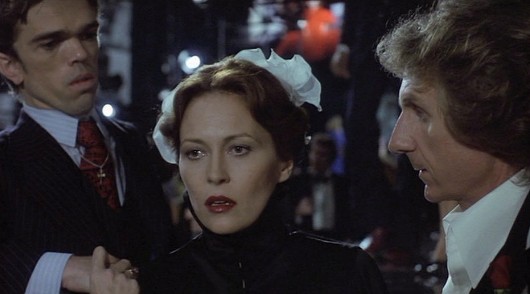 Who would want to bump off Laura's associates? An uncouth detective named John Neville (a pre-hard-target search Tommy Lee Jones) is put in charge of the case, and proceeds to question all the people who work for Laura. A miscellaneous group that includes her "flamboyant" manager Donald (the terrific Rene Auberjonois), a couple of models named Lulu (Darlanne Fluegel) and Michele (Lisa Taylor), her jealous ex-husband (Raul Julia), a lace-obsessed sycophant (Michael Tucker), and Tommy (the always awesome Brad Dourif), her twitchy chauffeur/bodyguard. I won't mention all the other folks Neville has his eye on, but I feel I gotta make at least a passing reference to the little person who stands behind Laura at her big gallery show (one that features the sublime photography of Helmut Newton and Rebecca Blake). Let's just say, he was very peculiar, and not because he was small in stature. I don't know, there was just something about the way he just lingered in the background in the two scenes he's featured in that didn't seem right. I guess it's what they call in the mystery business: a diversionary tactic.
 Even though the hackneyed "(Shake, Shake, Shake) Shake Your Booty" by K.C. and the Sunshine Band is the song playing during the hubbub of Laura's trendy expo, what I heard in my head was Visage's "The Anvil" thumping oh so coyly on the soundtrack as a bubbly Darlanne Fluegel monopolizes the proceedings with a breathtaking ease. Sure, the sleek, posing-friendly new wave jam was still swimming around inside Midge Ure's subconscious in 1979 (it would come out three years after this film was made), but I still think it would have been the more appropriate choice.
 Awash with red herrings and other plot-based doodads that are customary to the genre, the real star of Eyes of Laura Mars are the film's two main photo shoots. The first one being the infamous "coats and lingerie" shoot in the middle of a busy New York City intersection. Infamous because it's downright bizarre (models claw at each other's crimped hair while two wrecked cars burn in the background), the sequence depicts the artistry and the hard work that goes into creating your average fashion magazine photo spread. Working closely with the models and the hair and makeup people, Laura is like a conductor, commanding the chaos with her discerning lens. Still an influence on modern day pop culture (watch the fur and fire fly in the music videos for "The Dominatrix Sleeps Tonight" by Dominatrix and Lady Gaga's "Bad Romance"), the scene, partially set to the funky strains of Heatwave's "Boogie Nights," is a tour de force when it comes portraying the excesses of the fashion industry.
 I don't think anything can come close to topping the sight of Darlanne Fluegel (To Live and Die in L.A.) and Lisa Taylor pretending to wrestle with one another in lingerie.
 Saddled with the unenviable task of following the coats and lingerie pièce de résistance, the second fashion shoot, despite the fact that two of their amiable colleagues have been brutally murdered (the world of high fashion must go on), finds the diligent crew stetting up shop on the upper floor of Laura's studio, a spacious warehouse located on the Hudson River. An elaborate piece that I like to call, "the new wave bullet wound shoot," starts off by having each model strike a fierce pose. With the exception of a male model dressed in a tuxedo, all the models seem to be in a sort of trance. The breeze emitting from an industrial fan causes the loose fabric on their sheer clothing to sway violently, giving the scene a strange heavenly quality.
 Unlike the gallery exhibition sequence, there's no need to fix the music, as the disco classic "Let's All Chant" by the Michael Zager Band creates just the right mood. The way the scene builds up to the "Your body, my body. Everybody move your body" part of the song was timed perfectly.
 Next to the sight of the models fighting in front of those burning limousines in Columbus Circle, I'd have to say that my absolute favourite image in the Eyes of Laura Mars was the shot of a slick-haired Darlanne Fluegel, now wearing a pink see-through ensemble, pouting while holding a small revolver. Not only did it wonderfully capture the whole "What I'm trying to do here is blur the line that separates style and violence" vibe the film seemed to be going for, it had a fashion forward temperament about it that practically screamed: clinically-proven cyborg assassin with a makeover.
 If I was forced to spend in an inordinate amount of time stuck in either one of the ocular cavities of any actress on the planet, the incomparable Faye Dunaway would definitely be one of my first choices. In the vicinity of her intense eye region–the film is called the "eyes" of Laura Mars and not the "ears" of Laura Mars for a reason–every time she would get a ghastly vision, you couldn't help but feel as if her eyes were slowly starting to become your eyes as the film progressed. If only I could say the same for her bone structure, as I would kill for her cheekbones. Oh, the things I would do if I was Faye Dunaway in the late 1970s.
 Speaking of her body, only someone completely cognizant about their inherent legginess would wear the kind of skirts Faye Dunaway sports throughout this movie. Some boasting as many as three slits per garment (you heard me, three slits!), Faye is one of the few actresses with the rare talent to appear leggy onscreen, yet seem overdressed at the same time.
 Integral to the plot, but frustrating from an aesthetic point-of-view, the manner in which each photo shoot was cut short by Laura's murderous visions was frustrating at times. The realization that "fashion" was being literally being killed off filled me with a great deal of sadness. It was like watching the world gradually drained of its chicness. It makes you just wanna put a trashy cocktail dress, call up Amanda Lear and Margaret Trudeau, do a bunch of cocaine, and hang out at Studio 54 for twelve hours straight. Purple garter belts forever!
* Barbra Streisand's "The Prisoner" opens and closes the film
video uploaded by robatsea2009
...


