Monday, June 28, 2010

They're Playing with Fire (Howard Avedis, 1984)

In the mediocrity-laced afterbirth that is now, the sight of an older woman seducing a much younger man has become so commonplace, that you can't seem to go anywhere, entertainment-wise, without running into some disproportionately aged pairing flouting societies meaningless rules and regulations. Whether it be poorly made porn or overly smug TV shows, this not-so newfangled combination has reached its saturation point. Particularly in the former, where the women are barely thirty, reek of cosmetic surgery, and the guys violently prodding at them with their veiny malformations look like musclebound sexual predators straight out of an inexplicably published gangbang how-to guide. Anyway, as the more discerning amongst us would expect, I was rather taken aback by the nonjudgmental nonchalance in which They're Playing with Fire goes about laying the groundwork for the mismatched venereal alliance at the centre of its tawdry mire. Maybe it had something to do with the fact that the adolescent male had an extra boyish quality about him, or maybe it was because the more experienced female literally oozed sophistication. Either way, I found their pairing to be quite mischievous–you know, as supposed to off-putting and sad. In fact, their relationship was so mischievous, I couldn't help but notice that male's face barely reached the apex of the female's bumpy acreage whenever he was seen trying to vigorously plow through her bawdy wheat field.

Yet another sleazy film from writer-director Howard Avedis and writer-producer Marlene Schmidt (Miss Universe, 1961), the husband and wife team who brought us the definite article obsessed trilogy that consisted of The Teacher, The Stepmother and The Specialist, They're Playing with Fire sees them (with the help of famed cinematographer Gary Graver) continuing to explore the realm of pampered dissatisfaction; a world that is crawling with seemingly well-off citizens who always seem to want more out of life.

This desire invariably revolves around money and sex. And since it's the 1980s, a time when the pressure to succeed was at its zenith, having a respectable job is not enough to fulfill the pricey needs of the era.

Even though the film's poster misleads us into believing that we're about to watch a lighthearted sex comedy along the lines of My Tutor and Private Lessons, the sinister underbelly of this trashy undertaking unveils itself when a first-year student, Jay Richard (Eric Brown), at Oceanview College is coerced by his English professor, Dr. Diane Stevens PhD (Sybil Danning), and her psych professor husband, Dr. Michael Stevens (Andrew Prine), into burglarizing the palatial home of the latter professor's rich mother.

The intent is to scare his churlish mother (K.T. Stevens) and wheelchair bound grandmother (Margaret Wheeler) into moving to a nursing home. Of course, the plan goes terribly awry from the get-go, as mother Stevens gets wise to the break-in and chases after Jay with a high-powered rifle. Luckily for Jay she's not much of a markswoman.

Apparently, Mr. Stevens' mother does not approve of Mrs. Stevens; she's low-class and totally beneath them. The only way he can get hold of any inheritance is to prove to the lawyers that she's mentally unstable.

After Jay flees, another visitor shows up moments later and murders mommy and granny. Wondering how the plan went, Mr. and Mrs. Stevens and Jay go back to the house later that evening. The traces of blood on the wall cause the married professors to suspect that their student accomplice did something untoward to the two elderly women. Much finger pointing ensues, and the threesome begin to play an unsavoury game with one another.

Who killed the old ladies, and who had the most to gain?

Approaching the material with a workmanlike efficiency, Howard Avedis brings his trademark no frills technique to the sordid project. It's true, he doesn't bestow a high energy montage on us (he's a product of the mostly montage-free 1970s), but he does manage to arrange it so that Sybil Danning ends up in a state of undress near the end of every scene she is in. And from a pragmatic point-of-view, that's all that really matters. It is clear that Mr. Avedis saw early on that Sybil was the film's greatest asset, and, like any rational person would, attempts to utilize her natural gifts at every turn.

While Sybil Danning nakedness is always a plus, the structurally sound actress managed to enliven the genitals of the great unwashed no matter what she had or didn't have on. One of the most visually pleasing women to walk the lumpy surface of Rigel 7, the seductive Austrian exudes an animalistic allure as the sultry English professor with killer thighs. The sight of her merely walking from place to place was intoxicating. Whether running long distances in heels or lounging on the deck of her yacht, Miss Danning brings new meaning to the term: elegant practicality.

Which brings me to her co-star. Now I don't know exactly what his deal was, but the indifference Eric Brown displays as Sybil's character is straddling him was dumbfounding. He could have been suffering from a severe case of "I can't believe my unworthy freshman cock is sploshing around inside Sybil Danning-ittis," or maybe he was just a player with super mad lady skillz. After all, he is seen throughout the movie repeatedly rebuffing the advances of an attractive classmate/amateur private eye (the extremely expressive Beth Schaffell*). But still, I didn't really get that much of a man-about-town vibe from him. I guess it's just one of those inexplicable things that defy explanation. Much like the wonky twist this flick tries to pull off during its inevitable conclusion.

Most Howard Avedis films end at around the 95 minute mark, and this one is no different.

* Having lost the ability to evaluate the quality of a movie acting back in 2004 (I blame a dangerous combination of Napoleon Dynamite and Xanadu), I wasn't sure about the temperament of Beth Schaffell's performance as Cynthia, the gal who pesters and spies on our young hero. Call me meshugana, but something seemed a tad off about her. And while a part of me did enjoy the idiosyncratic nature of the many strange faces she sports in this film, the other half had a sneaking suspicion that she was not doing this on purpose. In other words, she was merely a terrible actress.

In all my years of looking at stuff, never have I been this conflicted by the work of an actress in a motion picture. Which is sort of compliment, especially when you consider the fact that the film features Sybil Danning getting undressed in every other scene. Oh, and as is the case with the majority of performances of this type, this was Beth's lone screen credit.


...

Monday, June 21, 2010

The Lair of the White Worm (Ken Russell, 1988)

The greatest film ever to feature a hallucinatory flight of macabre fancy, one that was induced by simply touching a wall mounted crucifix that had been slathered with a generous dollop of corrosive green venom, The Lair of the White Worm is a seductive masterwork of perverted deviancy. Mixing rural backwardness with state-of-the-art technology (a character can be seen at one point fiddling with a compact disc*), mythological horror with campy playfulness, and boasting a enough close-up shots of nylon stockings to drive someone who has a fetish for that sort of thing into a hosiery-based stupor, this Ken Russell (The Devils) directed lark, based on the novel by Bram Stoker, is a bizarre trip through the wormy labyrinth of an English town called D'Ampton. It's true, I could have used a little more dreamlike lunacy and a little less spelunking. But the flame-ridden, gang rape heavy freak-outs we do get were so memorable in terms of impaled nuns, untoward thrusting and prancing snake women with blue skin, that you will no doubt forgive the fact that they're sparingly employed. The story of two floppy-haired gents teaming up to battle a gigantic worm, and its lingerie-friendly helpers, the film begins and ends with a colossal hole. Genital in appearance, one opening is natural, while the other seems artificial. Of course, the exact details pertaining as to how each hole came to be are not important. (I had this whole tangent that involved a lot of crude wordplay ready to go, but I somehow lost the vaginal fortitude to carry on.)

What is important is that I mentioned the floppy state of the two male protagonists' hair. One of the first things we see (besides the hole) is the wind tussled hair of Angus Flint (Peter Capaldi) as he is about to discover the skull of a mysterious creature buried alongside a small collection of Roman coins. Popping into my mind like a thunderbolt as he dusted off his creepy find was the thought: Where's Hugh Grant? I mean, who is this floppy-haired impostor? Well, apparently this film has two actors with floppy hair.

You see, Mr. Grant plays James D'Amption, a so-called "nobleman" who has family connection with the worm in the film's title, and just happens to have a follicle traffic jam playing out over and over again on the surface of his forehead.

(I can't believe I passed on making vagina puns in order to babble incessantly about floppy hair.)

At any rate, the weird skull found by the archaeologically inclined Scotsman leads James, the Lord with a family history that revolves around fighting large slippery creatures, to come to the conclusion that something strange is afoot. This beckons him to take Angus, along with the Trent sisters Mary (Sammi Davis) and Eve (Catherine Oxenberg), whose parents have disappeared, to search the caves on the out skirts of town. (I loved how their mining helmets temporarily subdued the behaviour of their chaotic hair.)

Meanwhile, a dangerous temptress, who doesn't look like a giant worm, is lurking in the woods. She says she has a fear of snakes, but you could totally that Lady Sylvia Marsh (Amanda Donohoe) was down with reptiles.

You could also say that Lady Sylvia has a bit of a worm skull fixation.

Oozing a raw, unvarnished sexual magnetism, Amanda is a sinister delight as the predatory Lady Sylvia. In fact, every moment she was on-screen was a reason to be thankful. Wielding her slender legs with a reckless abandon rarely seen outside your average slab of 1970s-era Eurosleaze, Amanda is seemingly in a constant state of erotic entanglement. Whether lounging in intimidating lingerie or caressing Catherine Oxenberg's prestigious calves with a largish worm dildo while lounging (the woman loves to lounge) in a tanning bed, Miss Donohoe seems to relish the opportunity to a play a woman with a serpentine disposition.

Out of all the stark imagery in The Lair of the White Worm, I couldn't help but notice that a lot of people seem to be drawn the nightmarish temperament of the scenes that are a result someone becoming exposed to the poison coursing through Lady Sylvia's saliva. I, on the other hand, was immediately taken with Hugh Grant's kooky dream involving Amanda Donohoe, Catherine Oxenberg and Sammi Davis as flight attendants who are not afraid to show off the bluish resplendence of their stockings.

A Scotsman with a live grenade and an equally live mongoose in his sporran is swell and junk, but I'll take Amanda Donohoe and Catherine Oxenberg wrestling to synthesizer music in the aisle of a super-sonic jet over that any day of the week.

The chic clothing Amanda's Lady Sylvia wears throughout this movie should inspire someone to design an entire fashion line around them, as I have no troubling whatsoever imagining them strolling down the more perversion-centric runways of world.

Costume designer Michael Jeffery dresses Amanda in a wide array of sexy outfits. My personal fave being the tight brown getup she wore while sitting in a tree. (I'm still trying to figure out how she managed to get up there in those heels.)

Coming in at a close second was her blue flight attendant uniform. Which, like the majority of looks, is adorned with a pin or broach with a snake theme.

Her long white coat with a matching three-cornered hat was Lady Sylvia's introductory outfit, and I must say, it does an excellent job of establishing her unique sense of style. The fact that the many different types of nylons she sports throughout the movie were colour coordinated to fit her many moods was not lost on me. A snake sheds its skin in order to grow, and in turn, so does Amanda's slithery enchantress.

Now, like most people, I tend to wear the same thing everyday (an infrequently laundered pair of black sweatpants and a twenty-year old Front Line Assembly t-shirt). However, in the high end word of Lady Sylvia, changing clothes is second nature. The white nylons of her introductory outfit obviously represent the worm of the film's title (the film is not called The Lair of the Magenta Worm for a reason). Her brown nylons signify the soil of the earth, which is, you guessed it, the place where worms generally live. And the blue nylons, well, they stand for the large area, known in some circles as "the sky," that hovers over the soil of the earth.

You can't help but notice that none of the other characters in the film have a sense of style that can match Lady Sylvia's. I mean, floppy hair, gaudy prom dresses and frumpy sweaters can't compete with the intensity that only a pair of thigh-high leather boots can provide. Yet even though this struggle for fashion dominance ends up being a strictly one-sided affair, to see a character vanquish her foes in one particular field, while simultaneously have their perfectly proportionate ass handed to them from a good vs. evil perspective was fascinating on a number of misguided levels.


video uploaded by TSfilmvault

* I wonder if the Party Doll A Go-Go soundtrack by Double Vision is available on compact disc.
...

Monday, June 7, 2010

Pinball Summer (George Mihalka, 1980)

The sight of a haphazardly placed American flag languishing in the corner of a beaten-up gymnasium was the exact moment I knew this film was germinated on Canadian soil. Of course, I was already keenly aware in advance that is was a purely Canuck venture. I mean, really? Would the insanely adorable, Albuquerque born Hélène Udy (One Night Only) ever appear in a motion picture that takes place in the United States of America? I don't think so. But nonetheless, the manner in which Old Glory was thrown in a corner immediately clued me in as to what Pinball Summer (a.k.a. Pick-up Summer and Pinball Pick-up) was trying convey. And that is that nationalism, and all that nonsense that goes along with it, is unimportant when attempting to outsmart an unruly gang of bikers, sustain and employ a multitude of ambidextrous hard-ons, win a prestigious trophy that signifies greatness in the field of pinball, and badger a blithering git who owns an Excalibur (the car Linda Blair drives in Roller Boogie) all during the course of a single summer. Utilizing the well-worn, pop music accentuated driving montage followed by some plot massaging dialogue with a dash of conflict credo, the essence of this George Mihalka (My Bloody Valentine) directed venture resembles almost every other aimless movie made during this righteous era (the film definitely has a lot in common with its American cousins: The Van, Van Nuys Blvd., The Pom Pom Girls, and Malibu Beach). Except, this particular enterprise seemed extra determined to celebrate the wonders of nothingness.

If you think I'm kidding, the actual plot involves a pinball trophy. One that a biker named Bert (Thomas Kovacs) desperately wants to own. So much so, that he spends most of the movie trying to steal it. In hindsight, Bert probably could have won it legitimately–you know, had he spent a little more time practicing and a little less time scheming.

The main target of Bert's scheming seemed to centre around manipulation a pathetic figure named Whimpy (Joey McNamara), a tubby outsider who is in love with Bert's girlfriend Sally (Joy Boushel). Promising to except him as a member of his gang after the completion of certain tasks, the nefariousness biker uses Whimpy's innate vulnerability to get what he wants. Which, as I've already stated, revolves chiefly around the winning of a pinball trophy.

Unwilling to allow Wimpy to defile Sally's wonderfully freckled physique, Bert sets up an unsavoury rendezvous with Tracy (Eve Robin), a genial demimondaine.

Maybe it's a classic example of Canadians trying to overcompensate, but in terms of promoting nihilism, I don't think I've seen a film so hellbent on destroying the very fabric of society. The main characters don't just belittle those who have goals and aspirations, they even openly mock the so-called rebellious citizens who inhabit their pathetically assembled excuse for a universe.

A prime example of this wanton belittlement is when we see van enthusiasts (i.e. exalted trailblazers when it comes to staying mobile during the fiery afterglow of the atomic hereafter), Greg (Michael Zelniker) and Steve (Carl Marotte), the supposed champions of the piece, take an unhealthy glee in tormenting Rod (Matthew Stevens) and Pam (Sue Ronne). Whether parked outside the diner, the arcade, or at the drive-in, Rod is bullied without mercy.

Sure, he's an uppity pratt, but there's no way he deserved the kind of harassment he endures in this film. It's true, I have no idea what transpired during the school year–Rod could have been a mammoth nozzle containing many douche-like properties in class. Either way, getting your tailpipe stuffed with three hot dogs, one hamburger, an entire pizza, and a loose smattering of popcorn is pretty harsh punishment for being a pompous ass.

The tactile nature of pinball and the lived in quality of the flesh the characters wear throughout this cinematic composition gave the proceedings a strong physical temperament; a disposition that I find to be severely lacking in the modern day aesthetical spectrum. The pelvic relationship one has while playing pinball communicates such a distinctly copulatory aura, that even the most shiftless of viewer could have picked it up without expelling much mental exertion. Each frustrated hump you hurl towards the flickering wood and glass case is tantamount to witnessing a psychosexual maelstrom. The thrusting represents fertilization and the racking up of points symbolizes the increase in population. As in, every point earned is a sentient being that you and the game have sired.

One's desire to see unclothed bodies (specifically female breasts, genitals, the subtle fracture of a backside) cavort in a shameless display of nakedness is repeatedly rendered obsolete. Which begs the question: Is the sight of an uncovered human female breast still important? I guess. Yet, it's that doubt that makes the film so successful as a flavourful slice of frivolity; one that just happens to celebrate spiritual autonomy and use arcade gaming as a metaphor for procreation.

Unequivocally proving that you don't need nude torsos engaging in acts of dehumanizing debasement to make something sexy, Pinball Summer (a.k.a. L'Arcade des cinglés) brilliantly teases the dampish reproductive organs of its sophisticated audience by aggressively employing the fabric-depleted clothing of the period.

You see, by leaving certain areas covered with small bits of denim and polyester, our interest in the regions that are uncovered only manages to increase in size.

I guarantee that all your crotch-based inclinations will be so fixated on Joy Boushel's exquisite thighs and freckled arms, that you will be letting out exaggerated yawns by the time she rips off her leopard print bikini top during an impromptu game of strip pinball at a backyard pool party.

Okay, maybe that's a little far-fetched–her boobs are quite resilient. However, that doesn't mean Karen Stephen and Hélène Udy don't shine bright in the scantily clad department as Donna and Suzy, the lovely gal pals of Greg and Steve. Always informally dressed, yet never undignified, Karen and Hélène make terrific use of their legs in series of lackadaisical montages that exemplify the importance of adhering to the leisurely values that make this nation soar upwards.

I also liked the way Donna and Suzy were constantly being thrown around by Greg and Steve. Not in a violent way, but in a playful, let's toss these petite women around like half-inflated sex dolls, kinda way.

However, the cushy, toss-friendly nature of their relationship is severely tested when Donna and Suzy are driven home by a suave fella in a white Corvette Stingray Coupe after a night of hot disco dancing at the Oz Club. It's too bad Greg and Steve are a part of that whole misguided disco sucks movement, because instead of harassing their nemesis (parthenogenesis) in the Excalibur at O.J.'s Drive-In, their lame asses should have been at the disco with their girlfriends.

Meanwhile, over at Pete's Arcade, the competition is heating up, as Joan (Joan Garnett), Lynn (Dawn Dowling), Brenda (Brenda Claire Hall), Kathy (Kathy Pedersen), Sally (Joy Boushel), Suzy (Hélène Udy), and Donna (Karen Stephen) all vie for the title of "Pinball Queen."

Judging the ladies via a device called the "clap-o-meter," my heart sank when Joan's beautiful body seemed to barely register on it. I'm no conspiracy theorist, but I think the contest was rigged. Either that or the unwashed rabble assembled at Pete's have no idea how to properly appreciate a delicious set of calves.

The fact that a television set is clearly shown in the "off" position (in other words, there was no picture being transmitted) and the drive-in movie the characters go to see was basically ignored signified to me that these people are not spectators, but fully integrated members of society. Sure, they're slowly sowing its downfall, but they're having an absolute blast doing so. A sobering message, if you ask me. But please don't, my brain is 93% belly button lint.


video uploaded by hotchickfan
...

Friday, June 4, 2010

Anguish (Bigas Luna, 1987)

It's a good thing that I like to sit way in the back whenever I find myself at the movies, or else I would have been extra paranoid about the prospect of a scalpel-wielding madman (one with intense mommy issues) sitting behind me waiting patiently for the opportunity to forcibly remove my eyes. Exploiting everyone's innate fear of having their eyes wrenched out in a public place, Anguish (a.k.a. Os Olhos da Cidade São Meus) is an expertly crafted slasher with a twist from Bigas Luna (a Spanish director mostly known for erotic comedies like, Jamón, jamón and Golden Balls). When I heard that there was going to be a special screening of this one-of-a-kind cinematic experience in my town, I thought: "Maybe I'll just buy the DVD. I mean, do I really need to see Zelda Rubinstein (Teen Witch) on the big screen?" Well, after seeing it in an actual movie theatre (one eerily similar to the two featured in the film), I can safely say that this deeply weird endeavour definitely needs to be seen at a proper movie theatre. Of course, I wouldn't go as far as to say that it is essential that one see it at an old timey movie house. But the amount of real life apprehension one feels cannot be discounted, as the temptation to gingerly look behind you to make sure Michael Lerner (Barton Fink) wasn't lurking back there with an alarming array of scalpels must have crept through the minds of at least a half the audience at one time or another. Sure, this particular group was a hardened collection of hardcore horror fans (the kind that wear black heavy metal t-shirts, sport goatees, and laugh at decapitations), but it's human nature to be concerned about what's plotting their demise in the darkness.

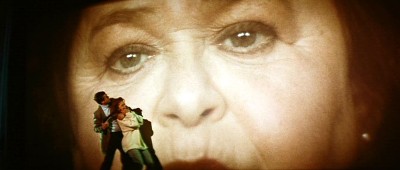
One of the most interactive horror films ever made, the overwhelming sense of dread the characters feel, especially the one's played by Talia Paul (It's My Party) and Clara Pastor, Anguish is two movies in one. You think you're watching a ghastly horror flick called "Anguish" (that's what it says on the marquee), but in fact, you're watching something called "The Mommy."

The morbidly straightforward–but no less odd–"The Mommy" is about an eye doctor named John (Michael Lerner) who has a bit of strange relationship with his mother Alice (Zelda Rubinstein). A dissatisfied patient (Isabel García Lorca) scolds the doctor for his uncaring demeanour while she suffers with a painful pair of contact lens. This dissatisfaction somehow gets back to John's fiercely protective mother (she can hear what John hears). Putting her son under hypnosis, Alice prepares his mind and body for a night of eye gauging restitution.

After the dissatisfied patient and her classical music loving boyfriend are rendered dead and eyeless, John returns for another session of mommy-based hypnosis in their modest apartment, which is overrun with snails and pigeons. Apparently the hospital has become dissatisfied with John's work. And you know what that means? More eyeballs are to be separated from the warm, gooey embrace of respective their sockets.

It's when John is returning home from his first eye job that we learn that we are actually watching Anguish, a movie about a couple of teens watching a movie called "The Mommy" in a crowded theatre full of popcorn munching matinee fans. While the faces of the audience all seem to be transfixed by the unseemliness that is transpiring up on the screen–they appear indifferent, almost desensitized by the violence (their cow-like chewing technique helps sell their blase attitude). However, the look on Patty's (Talia Paul) cute mug is one of pure terror. To say that "The Mommy" is causing her a shitload of distress would be an understatement. Her friend Linda (Clara Pastor) tries to placate her telling her, "it's only a movie," but that doesn't seem to help at all.

Things get worse for Patty when John decides to accumulate more eyeballs at the local movie theatre (their showing an old dinosaur movie). Encouraged by the demonic voice of his mother in his head, John goes systemically row by row dispatching audience members, and, of course, taking their eyes. The level of ocular violence that is occurring on-screen is so intense for Patty, that she goes to the room where ladies pee for a much needed break.

It's hard to believe, but things actually get even worse for the sensitive little scamp, as the line between entertainment and reality become so blurred, that Patty and Linda might have a killer in their movie theatre as well. Two movies, two killers with mommy issues, or is that three movies? Some of the fleeing scenes in the dinosaur movie seemed to mirror the action in "Anguish" and The Mommy."

I think might have let out a mild sigh of relief when the transition from "The Mommy" to "Anguish" was made. No offense to Zelda Rubinstein and Michael Lerner (who are both outstanding), but the idea watching an unhinged eye doctor, cheered on by his equally unhinged mother, collect the eyeballs of everyone in the city isn't that appealing.

Don't get me wrong, I loved watching their deranged antics. It's just that the introduction of Patty and Linda, while it didn't exactly soften the sense of menace (it actually ramped it up), it did give Anguish an added element that most horror films seem to lack: Originality.


video uploaded by Blue Underground, Inc

...