Showing posts with label Christian Borromeo. Show all posts

Sunday, September 1, 2013

Tenebre (Dario Argento, 1982)

Try to refrain from teasing Doberman Pinschers and always make sure to check the pulse of demented serial killers after they have supposedly slit their own throat with a razor. I don't know 'bout you, but I think these two pieces of advice will probably help four, maybe five people in the audience. In other words, they're not the kind of situations most of us will encounter over the course of your average day. However, there are literally millions of dark-haired Italian women out there, most likely dressed in all white, who will watch Tenebre in the hope that they might be able to pick up a few tips here and there on how to survive an attack by a razor-wielding psychopath with a grudge against society. Unfortunately, judging by the number of dark-haired Italian women who are stabbed, slashed and sliced to death in this movie, you could view it as a sort of guide pertaining to what not to do when confronted with a faceless killer wearing black gloves. I was going to suggest that maybe the dark-haired Italian women should arm themselves–you know, with a weapon of some kind. But then it dawned on me, in the film's most famous death scene involving a dark-haired Italian woman, the dark-haired Italian woman in question is holding–what I presume–is a loaded hand gun. The poster-girl for serial killer preparedness, the dark-haired Italian woman holding the loaded hand gun–get this–ends up losing the very hand she is holding the loaded hand gun with. I'm no forensic pathologist, but you can't cut off someone's hand with just one swipe from a razor. It's true, you can't. But who said the killer is using a razor? Uh, you did. Oh, yeah, that's right, I did. Well, the killer is now using an axe. And, as we all know, axes are perfect for chopping off hands. They're also perfect for redecorating a bland-looking white wall. Come again?!? I'm not following.


You see, when the axe cuts through human flesh, torrents of blood spew through the air. And if the person whose been hacked with an axe is standing next to a wall–preferably a white wall–it will instantly turn red. Getting back to my original point, if you're a dark-haired Italian woman and you were hoping to get some helpful pointers on how to survive an elaborately staged murder scene in a Dario Argento film, you're plum out of luck.


According to this film, which features the talented one two punch of Lamberto Bava (Delirium: Photo of Gioia) and Michele Soavi (Stage Fright) as first and second assistant directors (the latter appears as an actor as well), you're only chance for survival is to stand near a pointy avant garde sculpture and hope it falls in a manner that ends up putting the assailant permanently out of commission.


Why are you trying to give dark-haired Italian women tips on how to survive a Dario Argento film? I don't like to see people killed, especially attractive, dark-haired Italian women. Really? I don't buy it. In fact, the only reason you're watching this film is to see attractive, dark-haired Italian women murdered. I'm shocked that you would think that. Okay, try to imagine Tenebre without its four signature murder sequences. Oh my God! I'm not watching that. Fine. I like to watch attractive Italian women with dark hair murdered on film. Is that so wrong? You know what, don't answer that.


Besides, just as many men are murdered in this film than women are. I know, that doesn't exactly make things any less awkward. But still, it's comforting to know that men are murdered as well. Of course, the scenes involving men are nowhere near as stylish or exhilarating as the one's that feature dark-haired Italian women buying it.


Oh, in case you're wondering, the reason I call them "dark-haired Italian women" is because that's what they are. But the real reason has more to do with the fact that I don't know their names yet. What I mean is, I'm not familiar with the actresses who play the victims, and each time I call them "dark-haired Italian women" I feel as if I'm getting closer to knowing who they really are.


The film opens with a writer Peter Neal (Anthony Franciosa), one who specializes in sleazy murder mysteries, ridding to the airport, oh, let's say, LaGuardia, on his bike. As he's about to get on a plane to Rome, we notice that Jane (Veronica Lario), a dark-haired [possibly] Italian woman dressed all in white, is watching the author with much interest.


Meanwhile, in Rome, Elsa Manni (Ania Pieroni), a dark-haired [definitely] Italian woman dressed all in...wait a minute, her skirt is clearly pink. Whew! That's a relief. I thought for a minute there she was about to get murdered. Why are you looking at me like that? I thought you said only dark-haired Italian women dressed all in white are the one's who get brutally murdered in this film. And, from where I'm sitting, Elsa is not wearing all white. Let the scene play out first, you'll be pleasantly surprised.


Caught shoplifting a copy of Peter Neal's latest book "Tenebre," Elsa manages to weasel out of being charged by promising to have sex with the store's detective at a later date. Hitching a ride home on the back of a friend's motorcycle, Elsa's troubles aren't over as she has to contend with the grabbing hands of an unwashed derelict. Kicking him in the balls with her dark pumps, Elsa is able to get behind the gate of her home in time before the unwashed derelict can start grabbing at her again. Taking off her dark pumps (the real hero in the altercation with the unwashed derelict - Dark pumps. The very best there is. When you absolutely positively must kick the balls of every last unwashed derelict in the room, accept no substitutes), Elsa proceeds to remove her...


Stop! Don't remove your pink skirt that's pleated near the bottom. Don't you get it? Once you take off your pink skirt that's pleated near the bottom, you'll be wearing nothing but clothes that are white. Bah, what's the worst that could happen? Don't say I didn't warn you.


Wearing nothing but a white top, Elsa notices her phone isn't working. And just as she's about to turn around to do something Italian, a razor is being held to her throat and black gloved hand is stuffing pages of "Tenebre" into her mouth. I don't think I have to tell you what happens next.


Greeting Peter Neal at the airport in Rome is his agent, Bullmer (John Saxon), and a group of reporters, including Tilde (Mirella D'Angelo), a staunch lesbian who doesn't like the fact that her girlfriend, Marion (Mirella Banti), fucks dudes for money on the side.


You know this film needs? It needs some Daria Nicolodi. Oh, wait, there she is. Playing Anne, Peter Neal's secretary, Daria Nicolodi, you'll notice, has red hair, yet she's dressed in all white. I'm confused. I mean, it doesn't say anything here about redheaded Italian women dressed all in white. Oh, man. I don't know what to think now.


At any rate, when Peter Neal, Anne, and Gianni (Christian Borromeo), Peter Neal's youthful assistant, arrive at the hotel, two detectives, Det. Germani (Giuliano Gemma) and Inspector Altieri (Carola Stagnaro), are waiting for them. Informing the writer about the gruesome manner in which Elsa Manni was murdered (like I said, pages from his latest bestseller were stuffed into her mouth), the police also show him a menacing note from the killer that was sent to his hotel room.


While technically not a brunette, the gorgeous Eva Robin's (Bad Inclination) appears during these strange flashback  sequences that take place on a beach; hence the reason she's credited as "Girl on Beach." Dressed in a white dressed and wearing red pumps, Eva Robin's is surrounded by a bunch of faceless boys. One of them slaps her hard in the face, causing the other boys to tackle him. As they pin him to the sand, Eva Robin's strolls over and proceeds to shove the heel of one of her red pumps into the mouth of the boy who slapped her. (Red Pumps. The very best there is. When you absolutely...) I don't know what this has to do with anything. But I'm guessing it's a painful memory pulled directly from the mind of the killer.


All right, I think I've waited long enough. The electro score by Goblin is one of the best I've ever heard. Seriously, I'd put it up there with Wang Chung's To Live and Die in L.A. score and Chuck Cirino's score for Chopping Mall in terms of synthy greatness. And while we heard the theme from Tenebre during the opening credits. It doesn't really get a chance to display its utter awesomeness until Mirella D'Angelo and Mirella Banti are confronted by the killer in their swanky home, where the former is attacked while putting on a t-shirt–a white t-shirt–and the latter is attacked while wearing a towel–a white towel.


However, before the attack occurs, we given an extended tour of the roof of their house. And it's during this tour that I really started to appreciate the throbbiness of Goblin's score. It can't say enough good things about the music in this film, as it's the type of music I wish every movie had as its soundtrack. And when I say "every movie," I mean, every movie. Even Driving Miss Daisy and Edward Penishands.


You would think that the confrontation between the killer and the two dark-haired Italian women in their home would be the pinnacle of this film's greatness. Think again, pal. Sure, the camera angles, the music, the intensity of the violence featured in the previous scene are nearly impossible to top in terms of being iconic, but a plucky actress named Lara Wendal and a resolute Doberman Pinscher are going to try, nonetheless.


Playing Maria Alboretto, the daughter of the landlord of the building Peter Neal is currently living in, Lara Wendel's decision to taunt the Doberman Pinscher that barks at her during her walk home from a disastrous date with her boyfriend (Michele Soavi) will come back to haunt her.


She doesn't know it yet, but the Doberman Pinscher she is currently poking at with is a stick is the dog shit when it comes to jumping fences. After multiple attempts, it finally makes over the first fence, and just like that, the best dog chase sequence in slasher film history is underway. Now, some audience members might be shocked to learn that dog in question is 100% real. That's right, there's no CGI tomfoolery to be found during this epic chase.


Even though I might have missed a few along the way, I think at least four fences are scaled during this particular chase. Well, actually, if your numbers are correct, that's not entirely true, as Maria doesn't quite make it over the fourth fence. Oh, yeah. She doesn't, does she? Yeah, I forgot about that. Either way, the music cue that occurs when a black gloved hand lifts a razor in anger is fantastic. And the piece of music that accompanies the final leg of Lara Wendel's ordeal is called "Flashing" and it's just as amazing as the film's theme song.


Granted, I've seen and appreciated many forms of cinematic arterial spray over the years. But the type employed during the film's bloody finale was simply ridiculous. And I mean that in a good way. To call it "spray" doesn't seem to do it justice, as it's more like an arterial gusher. At first, I felt sort of bad for all people murdered in this film. Then it dawned on me. No, I don't feel sorry for them, I actually envy them. That's right, envy. Think about it. Who wouldn't want to be killed in such an elegant manner? To be killed in the gruesome mode the people are killed in this movie would be a honour and a privilege. I know, murder is wrong and junk, but if you're going to go, why not go in style?


While I'm currently in the process of re-watching some of Dario Argento's essential films, I can't imagine any of them coming close to topping the icy perfection of Tenebre. Now, if you'll excuse me, I'm going to crank the film's soundtrack while slowly pacing back and forth in a menacing fashion. I do have a pair of black leather gloves, but I don't own an open razor. So, instead, I'm using an old feather duster. Watch out dark-haired Italian women the world over, I'm going to straight up dust your ass.


video uploaded by macalus1

Friday, October 28, 2011

House on the Edge of the Park (Ruggero Deodato, 1980)

Does a movie have to take place inside an actual discotheque for it to be considered "disco chic"? Excellent question, random voice in my head. Well, after giving it some unnecessarily belaboured thought, I have come to the conclusion that, no, it does not. Sure, it doesn't hurt, but it's not like it's a requirement or anything like that. It doesn't matter where your movie is set, as long as it promotes the three tenants of disco culture. Which are: Dancing, fashion, and sex. You could set it in a condemned amusement park, a nail salon facing multiple health code violations, or even a swanky house located out in the wilds of New Jersey, if disco is treated with respect, you should have no problem whatever oozing disco chic. Speaking of New Jersey, House on the Edge of the Park takes place in the unfairly maligned state, does it ooze disco chic? You wouldn't think so considering the fact that at no point is cocaine visibly ingested by any of the principal characters. But, as most disco connoisseurs will tell you, casual drug abuse was just one of the many aspects of the disco scene. Getting back to your question, I'd say, yes, this film, directed by Ruggero Deodato (Cannibal Holocaust), exudes plenty of disco-friendly peculiarities. And it's a good thing it does, because if you take away the film's chicer elements, all you're left with is a tediously long exercise that does nothing but openly promote violence and degradation. Boasting three pairs of stockings under varying degrees of structural duress, the bourgeois nightmare scenario this film puts forth, which, in truth, is actually a veiled expose on the ugliness of a society that is growing more and more shallow with every passing day, is too far-fetched to ever reach a level that is close to being believable. However, as a coarse examination of human cruelty, and the extremes some people will go through to make others suffer, this film has plenty to say, and it occasionally does so with a razor-like precision.

While watching the film, which, for the most part, takes place inside the posh living room of a house located out in the suburbs, I felt like I was looking down upon the figurative doll house I had as a child. Creating a series of sick and twisted storylines–ones that were so elaborate, that they could have been the basis of at least five poorly reviewed theatrical productions–I would dress my dolls in the latest fashions, bound the troublemakers with curtain rod cord, smear the recently beaten with tomato paste, and, of course, use the light emanating from the kitchen's open refrigerator to emphasize the mouth-watering tightness of a pair of white stockings (yeah, my doll house had electricity, and, it would seem, a working refrigerator). Now, some might say, I was an eccentric child. But others, the segment of the population who are not totally lame, might say that I was the epitome of off-kilter cool.

Weren't you shocked to see some of your doll storylines recreated in House on the Edge of the Park? Yes and no. Yes, I was surprised to see how close the refrigerator scene was to my version (even the manner in which the female character sat on the kitchen counter was the same). And, no, I wasn't surprised to see a film where two groups of people clash with one another in an enclosed space, as it's the basic foundation of all drama.

You'll notice I said, "two groups." Well, that's actual not true. Sure, there are two sides, but two people don't exactly constitute a group. Granted, Deutsch Amerikanische Freundschaft, Eurythmics, and Psyche are considered groups, and they only have two people. But in this situation, calling them a group is pushing it. On the other hand, Alex (David Hess), the leader of the undermanned group, while on the surface looks like a single man, actually possesses the properties of at least six fully grown men. Semantics aside, you know Alex is a card carrying psychopath even before the opening credits have started to role when he rapes a woman in the backseat of her car.

Demonized right out of the gate, there's no dark charcoal grey area with Alex. He's vile, vulgar, and extremely dangerous. Yet, he can also be quite persuasive. Anyway, the question you need to be asking yourself is: Who would be friends with a person like this? A sycophantic half-wit. Yes. A blithering coward with low-esteem? Uh-uh. Itching to go disco dancing ("are we gonna boogie?"), Ricky (Giovanni Lombardo Radice) is hounding his pal Alex, who is getting dressed in the office of the parking garage that he either works at or owns. I'm gonna say latter, judging by the quality of his suit he's putting on. If we hadn't seen Alex brutally assault the woman in the opening scene, we'd look at him with bemused indifference; tittering ever so slightly as he put on his comically garish yellow and cream coloured vest.

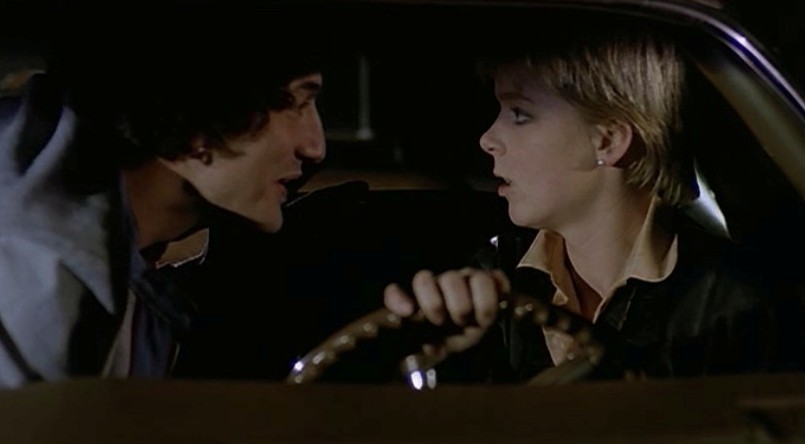
The other question should be asking is: Who would invite a person like this to a "get together" in the suburbs? It's true, two upscale prats from Manhattan, Tom (Christian Borromeo), a real dandified slice of ineffectual Eurotrash if I ever saw one, and Lisa (Annie Belle), a short-haired hellcat in all white, have no idea the man standing before them in the yellow blazer is will turn out to be one of the most loathsome characters in film history. But like I said, he possesses a certain repulsive charm. In that, part of you finds him to be utterly disgusting, while the other half is busy eyeballing the unclear magnitude of his trouser bulge.

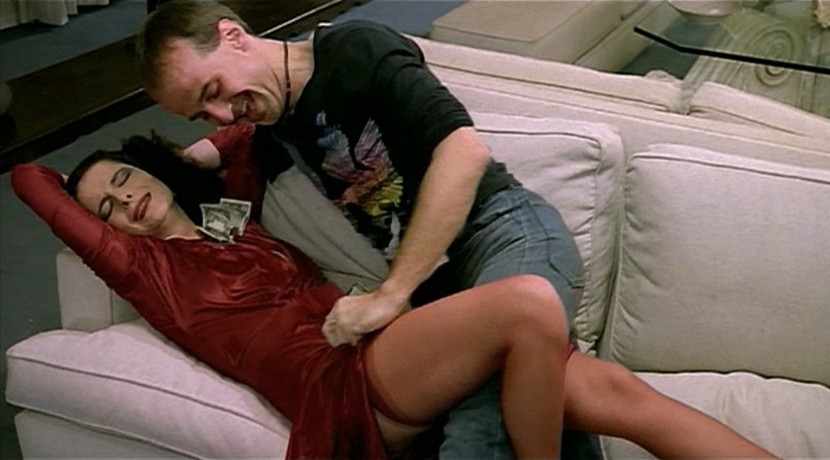
Hoping in the back of their car, Alex and Ricky are driven to a house, which may or may not be located on the edge of a park. Greeted at the door by the virile Howard (Gabriele Di Giulio), the black, bald, and beautiful Glenda (Marie Claude Joseph), and Gloria, who is played by the always gorgeous, always chic, Lorraine De Selle, Alex and Ricky quickly make themselves at home. After being egged on by the other guests, Gloria and Ricky start to dance to the ultra cool sounds of Riz Ortolani's "Do It To Me (Once More)." The sight of Lorraine getting down to this song is one of the film's defining moments. Swaying back and forth to the pulsating disco beat, the slit on the front of her red dress reveling the tautness of her equally red stockings with every hip-based oscillation, Gloria mesmerizes the dimwitted Ricky with an effortless aplomb.

Unamused by this tawdry display, Alex can be seen glowering in the corner (he thinks they're making fun of Ricky). In an attempt to placate his anger (she's the only one who notices that he's annoyed), Lisa takes Alex aside and sits with him on the couch. Since director Ruggero Deodato is an Italian man, the camera focuses on Lisa's white, stocking encased legs as they're being crossed. Hearing the sound of the rarefied hosiery attached to her legs grinding together as she crosses them (a talent most heterosexual men possess), Alex starts to molest her thighs. Allowing him to stroke her stockings proper and the fleshy no-man's land located between her stockings and garter belt for a few seconds, Lisa gets up and goes to the kitchen.

Following her, Alex continues to explore the aforementioned area. Using the light produced by the refrigerator to help him see what he's doing (Lisa is now reclining on the kitchen counter), Alex rubs his face over her upper thighs. And just like when they were on the couch, Lisa pulls her skirt back down to its pre-molestation position, gets up and walks away. You know Alex is going to follow her, and that's exactly what he does. Finding her in one of the upstairs bathrooms, Alex watches Lisa take a shower. Of course, this leads to them washing each others backs and some mild groping. But, as usual, it doesn't really go any further than that.

Meanwhile, back downstairs, Ricky is getting cleaned out by Howard, Tom, and Glenda at the poker table. Are they cheating the excitable dullard? I don't know, but, I have to admit, Tom's flush was a little on the sketchy side. Either way, a dried off Alex seems to think they are, and, after punching out Howard and holding his trusty straight razor to Tom's dainty throat, tells them that from now on they're playing by his rules ("now we're gonna have some fun with these cunts").

Winning all his money back with an unseen "royal straight," Alex tells the victorious Ricky that he can have first dibs on any of the three women in the room. Now, normally, I would say that his choice was an easy one, as Lorraine De Selle, her brunette hair swooped to one side, is alluring as all get out. But Lisa and Glenda are no slouches when it comes to inducing corduroy-based discomfort (your cock has nowhere to go when its sheathed in corduroy). Nonetheless, Ricky chooses Gloria. As he's about to grab her and take her upstairs, Alex demands that he, "fuck her here!" Not one to disobey his master, Ricky proceeds to fondle Gloria on the couch. Tearing off her red panties in a fit of red pantie removing rage (what a waste of a perfectly good pair of red panties), Ricky is just about to take his assault one step further, when, all of a sudden, Howard jumps to his feet, pulls Ricky off Gloria, and starts fighting with Alex.

With Howard subdued (they tie him to a table with some curtain cord), Alex and Ricky are to free harass the others at will. Only problem is, Ricky can't seem to rape Gloria. Taking a break from smashing figurines, Alex tries help out his pal out by rubbing his face against the upper part of Gloria's thighs–you know, show him the groping ropes. This doesn't work, as it would seem that Ricky just doesn't have what it takes to be a professional rapist. Like a father who wants his son to be next Wayne Gretzky, but instead turns out to the next Quentin Crisp, Alex is extremely disappointed that Ricky can't get it together, rape-wise.

In terms of judging the work of the four ladies who appear in the House on the Edge of the Park, there are only two women who are actually worth talking about, as, unfortunately, Marie Claude Joseph, who plays Glenda, and Brigitte Petronio's Cindy, a character who shows up later in the film, are basically used as props. With the exception of her half-assed escape attempt and a lesbian make out scene, Marie Claude just stands there while looking fabulous. And Brigitte? Well, she's just there to be tortured. Oh, sure, it's an effective scene, but her misery is pretty much meaningless.

No, I'd say Annie Belle (Bacchanales Sexuelles), as the feisty Lisa, and Lorraine De Selle (Women's Prison Massacre), as the debonair Gloria, were the only non-raping characters of note in this film, as they're the only ones who interacted with the two assailants. While I've already mentioned the three instances where Lisa toys with Alex, she actually does it a total of six times (and from where I'm standing, that's a lot of toying). Which is quite impressive, if you think about it. I mean, it takes a humongous amount of pluck to stand up a man like Alex. Firmly standing her ground during every single one of their encounters, Annie Belle, despite her delicate frame, doesn't back down once from the towering presence that is David Hess. While it's true, her counterpart in red seems to prefer the cowering in fear technique over the one Lisa was putting out there (you could probably smell the pheromones emanating from her pluck-producing pores for miles), the method utilized by Lorraine De Selle's Gloria was no less effective when it came to mollifying rapists. Though, to be fair, she was dealing with a lesser rapist.

I'm not sure if this had anything to with Lorraine, but I liked the way her character's red stockings seemed to get more torn up as the evening progressed (no one will ever accuse me of underestimating the importance of stocking continuity).

Whether uttering his trademark phrase, "hello, lady," bashing foppish yuppies, calling Gloria "Miss Muffet," slathering his coarse face over the thighs of stylish women in stockings, or cutting up wide-eyed party crashers in pink panties with a straight razor, David Hess is ferociousness personified as Alex, a man without a single redeeming quality. Okay, his fixation with garter belts and stockings made a lot of sense (he instructs Lisa to keep her creamy stockings on before ravaging her). However, I don't think liking a specific article of women's clothing lets you off the hook for all the evil deeds you have committed. If anything, it would make me despise you even more. At any rate, the manner in which David Hess embraces the uncompromising cruelty of his character was a thing of sadistic beauty. Come for the disco chic, stay for the slow-motion "whoa, you just shot me in the crotch" grimace sequence, it's a doozy.


nsfw video uploaded by GrndhouseTrailers
...