Friday, February 27, 2009

Valley Girl (Martha Coolidge, 1983)

There are two distinct chapters in my life: Before Valley Girl, an appalling netherworld where magenta is nonexistent and everything for as far as the eye can see is covered in a suffocating layer of drabness, and after Valley Girl, a gleaming, effervescent place in which your average leg warmer isn't just a wooly thing that covers your legs, but a full-bodied cornucopia of bold colours and unique possibilities teeming with nuance and guile; a place where idiosyncratic social groups can commingle with one another to eat complicated sushi without fearing an unexpected kick to the crotch. Now, I don't think I have to tell you which realm I prefer living in, but just in case... Seriously though, I can't believe there was an actually increment of time where Martha Coolidge's seemingly accidental ode to passion and nothingness was not a part of my stunning existence. It baffles me to think that I once lived without knowing about the power of Randy and Julie's love for one another. A love that crosses so many boundaries, that it boggles the mind. I mean, he's a new wave punk from Hollywood and she's new wave preppy from the Valley. I'm no expert on L.A. geography, or alternative subcultures during the early 1980s, but that's got to be one of the most unorthodox pairings in the history of heterosexual dating.

Confounding shapely linguists and unhinged anthropologists since its righteous inception, Valley Girl represents a time and a place in the annals of human history that will never be duplicated. Which is why I treat each screening of the film as a sacred ritual. Sure, the clothes I wear as I watch the film may be the gothiest of jet blacks. But believe you me, and that creepy naked guy inhaling his own genitalia in the corner, my clothing is extremely pastel on the inside.

Ironically, it's colours and clothing that get the characters into so much trouble in this film. You see, when Randy and Julie first lay eyes on one another, they're at the beach and stripped of their tribal uniforms. However, when they meet again at a totally rad Val party, they're sheathed in their respective colours: Hers are light-coloured (lot's of whites, pinks, and soothing blues), while his are industrial (lot's of red and black, or, in much simpler terms, a Mussolini Headkick album cover come to life).

Anyway, this party scene is the nitty-gritty of Valley Girl, as we spend a good chunk of time there. In fact, every nugget of plot is launched at this swanky shindig: Fred's relationship with Stacey, the mother-daughter competition over a guy named Skip, Tommy's manipulation of Loryn, and, of course, Randy and Julie's first up close flirtation.

The way Randy and Fred standout at this Val party, and the way Julie and Stacey standout when the two aforementioned guys take them to a club in Hollywood, is the film's most compelling aspect. In that, everyone can relate to being dragged somewhere and end up feeling like an alien. This so-called cultural exchange feels natural because the talents of Nicolas Cage and Deborah Foreman as the film's signature couple. I found their looks of longing and desire to be genuine and the heat they generate during their stare downs to "Eyes of a Stranger" by The Payolas and "A Million Miles Away" by The Plimsouls is stuff of teen movie legend.

The switch over sequence, however, is sent into stratosphere in terms of honest-to-goodness whimsicality thanks to the brilliant acting of Heidi Holicker and Cameron Dye as Fred and Stacey. Heidi in particular, whose constant whining is expertly realized through a series of sincere complainants (the music was a tad on the loud side) mixed with obnoxious bellyaching (let Fred grope you, you prude).

On an aesthetic level, I loved Miss Holicker's thighs. They're prominently on display during the infamous sleepover sequence, and, to be perfectly honest, I wanted to Holicker them like you wouldn't believe.

The extended dating montage set to "I Melt With You" by Modern English is the pinnacle of extended dating montages. It's true, the song has lost some of its lustre over the years (it's been used to sell everything from cheeseburgers to low cost fallout shelters), but the moment the songs blasts on soundtrack never seems to fail in jazzing me for some forbidden romance Summing up the awe-inspiring splendour that is Valley Girl in just over three minutes, this montage pretty much shows the blossoming of Randy and Julie's love for one another in a tight little package.

Speaking of tight little packages, never has anyone looked cuter than Elizabeth Daily does when we see her dancing in nothing but pigtails and zebra print underwear.

The soundtrack is one of the greatest ever devised by humankind. The Flirts, Psychedelic Furs, The Plimsouls (the girl with the extra long bangs who is seen excessively dancing to them at the Hollywood club looks exactly like my most prominent high school crush), Felony, and Sparks, (the mother-daughter subplot involving the gorgeous Lee Purcell and Canadian cutie Michelle Meyrink features the most excellent "Eaten By the Monster of Love"), and Josie Cotton and her 1950s accented pop.

In closing, to say that life has been different since Valley Girl would definitely be an understatement. A rewarding cinematic experience like no other, the film changed the way I appreciate things. In other words, it has taught me how to love, like, totally. Ugh.


...

Wednesday, February 25, 2009

Psych-Out (Richard Rush, 1968)

Authentic hippie culture shot through an unfiltered lens, Psych-Out is a dandyish look-see into the lackadaisical head space of Haight-Ashbury, the grooviest intersection in all of San Francisco. Rife with furry vests, cannabis, pantless women, multicoloured headbands, irregular facial hair, and beads, the residents of this illuminated district bob and weave through life as if they're changing the world. But it seems that no one has told them that there's an army of belligerent squares waiting out in the wilderness to stomp their grass stained asses. You see, the militaristic aura that imbued the bulk of the twentieth century was more pronounced than the hippies anticipated, and defeating this warlike attitude through songs about mushroom pillows and canceled barber appointments was obviously doomed to fail. In fact, the veterans of these many conflicts were so attached to their military-style haircuts, that just the mere sight of a long-haired human male repulsed them. The characters that populate this slacker sanctuary are under the illusion that their safe to philosophize and hypothesize 'til the swamp is dry, but what they don't realize is that reality is dangerous and that their burgeoning existence isn't being dug by everyone. The perpetual clash between flower power values and the buttoned-down, fiscally responsible majority of the United States of America circa 1968 is touched on every now and then in this Richard Rush directed oddity. However, the main focus of the piece is centered on a deaf runaway named Jenny Davis (Susan Strasberg) and her desire to locate her brother Steve (Bruce Dern), a crazed artist known as "The Seeker." Helping the hard of hearing gal are the members of a psychedelic rock band called Mumblin' Joe. Particularly accommodative is their leader, Stoney (Jack Nicholson), who facilitates the wide-eyed imps transition into the hippie fold.

They also get advice from the reclusive Dave (a beautifully calm Dean Stockwell), a kind of lethargic shaman. Imparting wisdom like a baked sage, the plainspoken Dave sends the acid rockers and their shapely acquaintance in the right direction. Of course, they'll have to rumble with a gang of junkyard employees (Max "The Mack" Julien fights while high and imagines himself a noble knight), partake in a mock funeral (garage hipsters The Seed serenade the proceedings), and headline a gig with the totally awesome Strawberry Alarm Clock, before they can lay their eyes on The Seeker. But who said being a hippie didn't require making sacrifices? Actually, I might have said that. But then again, my donuts might be laced with LSD.

Trippy without being irritating, stylish without being incoherent, Psych-Out is a deceptively demure look at hippies in their natural habitat. The gorgeous outsider played by the insanely attractive Miss Strasberg is the perfect fish to help the non-hippie audience manouevre through this bathing lax subculture. A ponytail sporting Jack Nicholson, while unconvincing whilst holding a guitar, came off as moderately competent when came to making goo goo with his lovely co-star.
The complete opposite of the character he played in The Trip, Bruce Dern is an unhinged delight as The Seeker (I wonder if that was his real hair) and future suave fucker Dean Stockwell was righteously cool as Dave (I loved his composer under pressure).

The real star, however, was the dreamy music of Strawberry Alarm Clock. Even though they only appear briefly (they perform "Rainy Day Mushroom Pillow"), their music seems to permeate the film like a flighty head cold. Sure, I've heard "Incense and Peppermint" used in countless films and television shows over the years, but to hear it in an actual film from the period was a bit of a minor treat. Besides, I much preferred the way their little heard "The Pretty Song" was utilized. It opens the film and is played again during a love-making montage, and is a gentle ditty that caused part of my spirit to soar.


video uploaded by Welcome to the Sideshow!
...

Monday, February 23, 2009

It's a Boy Girl Thing (Nick Hurran, 2006)

This is the film I've been quietly demanding Hollywood North make for over five years. Now, I know what you're thinking, and no, I don't mean another in a long line of contrived body switching movies. Nope. I'm talking about a film starring the sparkly Samaire Armstrong, one of the most captivating actresses of this young century. I mean, I never thought I'd live to see the day when her sylphlike frame and flaky name would adorn an actual movie poster. It's like a wish come true; a misguided, mildly pathetic wish, but a true wish nonetheless. Upon further reflection, I kinda hoped she would have chosen to appear in a more original vehicle as her first starring role. But then again, it could have been worse, as It's a Boy Girl Thing is a light and frothy film that doesn't strain the brain muscles, and gives us a semi-positive message about gender and class without making the audience gag too hard. However, the fact this Nick Hurran directed film failed to bring anything unique to whole body switcheroo genre was a tad disheartening. Neglecting to fully explore the wonders of homoeroticism, for example, was just one of the many missed opportunities in this guy-gal affair.

The well-worn tale is about Nell (Samaire Armstrong) and Woody (Kevin Zegers), a pair of constantly bickering adolescents from opposite sides of their high school's social pecking order, who unwittingly trade bodies with one another after being exposed to an Aztecan sculpture at a museum. And like in, say, The Hot Chick and Freaky Friday, the two wake up shocked to find their flesh equipped differently. Forced to spend the rest of the story stuck with each others junk, the prickly twosome have roughly an hour and a half to learn to respect one another and themselves.

Unlike like most girl-boy exchange flicks, the particular one embraces the warm, scintillating bosom that is crude and bawdy humour. This unforeseen crudity is what helped me manoeuvre through this hackneyed mire more smoothly. Exaggerated silhouettes of an erectile nature, mob crotch waxing, naked shower scenes (male and female), menstruation gags, and references to semen caressed my ear region like a dirty rag. Also, you got to give up for a film that ends with a big football game (complete with late minute heroics) and a prom (complete with the crowning of a king and queen ). It's that kind of devil-may-care boldness that makes admire this film more than any sane person would possibly dare.

The main reason, however, for enduring such cliches was obviously to bask in the whimsical charms of Samaire Armstrong. Radiating onscreen like a demented enchantress (one who has just acquired the ability to be foxy in public), Samaire sent me flying into a pleasure-laden stupor with every crinkled nose and batted eyelash. It's true, she didn't quite master the male mannerisms... you know, beyond sitting with her legs apart (Kevin Zegers' feminine posture was a tad more convincing). But I'm not gonna let a little thing like improper manliness ruin a perfectly adequate Samaire experience. I mean, to see the svelte thespian cavorting in high heels and a plaid miniskirt, her newfound legs glistening in the bland Ontario sunshine, as the Scissor Sisters throbbed on soundtrack, was, to put it mildly, the stuff seedy dreams are made of. In other words, fuck your gender-related nitpicks.

Obviously parts were filmed in Toronto (I spotted Cherry Beach), It's a Boy Girl Thing is stuffed with Canadian faces. Maury Chakin (Whale Music) and Robert Joy (Desperately Seeking Susan) being two of the more visible ones (Zegers is Canadian, too). And the wonderful Emily Hampshire, whose bizarre performance in A Problem with Fear is legendary in my mind, has a nice off-kilter vibe as Chanel, a geeky teen who hangs with the so-called in-crowd. A potty-mouthed Sharon Osbourne and a piggish Mpoho Koaho round out the rest of the cast. The latter actually earns the majority of the film's genuine laughs. Which are few and far between despite the presence of the lovely Samaire.


video uploaded by CheesyPeteza
...

Friday, February 20, 2009

Party Doll A Go-Go!: Part 2 (Rinse Dream, 1991)

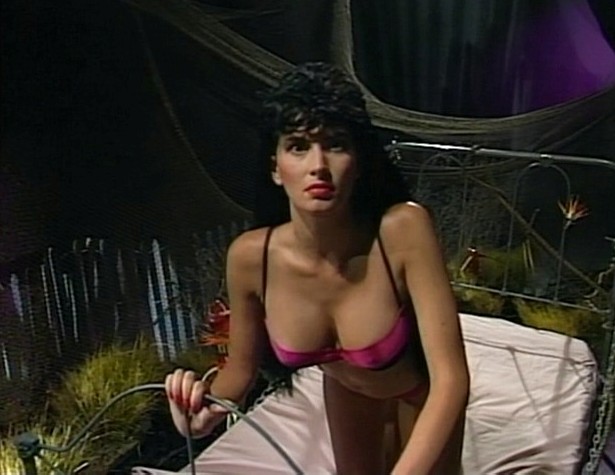
What must have the stained raincoat crowd thought when they inadvertently stepped in front of this chatty smorgasbord in 1991. It's not the clearest vision I've ever had, but I can almost make out their broken little faces crumbling under the sheer of weight of the weirdness transpiring on-screen. No fooling around, the operational integrity of their masturbatory instincts must have been severely compromised by this salacious enterprise. In that, the rapid fire manner in which it belittles the audience's erotic comfort zone is just as prominent as it was in the first chapter. Besides, given the fact that the radioactive lingerie, freeze-dried ornamental grasses, toxic space flowers, rustic fence materials, dangling clumps of rope, and the chain-adorned mattresses from the first film were probably still lying around the no doubt gamy-as-fuck set, and since the cast's genitals were already percolating with a lustful hunger, you'd be totally insane not to make Party Doll A Go-Go! Part 2. Taking what worked from the first chapter, jiggling it ever so slightly and not expanding on it one bit, all Stephen "Rinse Dream" Sayadian (the genius who brought us Dr. Caligari, Nightdreams, and Café Flesh) does is switch up the penetration pairings, change the licking order, move around the excellent music of Double Vision, and, boom, just like that, you've got yourself an equally unwell sequel.

If the first telecast celebrated irregular insertion, then part two downright glorifies it. Behold, as a wide array of avant-garde items are willfully jammed into crevices big and small. This cranny packing is made possible thanks to the generous assistance of the non-unionized members of a demented crew of sentient female persons: Jezabel, the mysterious one; Lannie, the lascivious one; Roxi, the kinky one; Vivian, the seductive one; Tantrum, the hippest one; Vera, the lubricious one; and Echo, the troubled one. All their rambunctious girl biscuits are hungry for firm boy jerky. Well, some are itching for the taste of a special kind of secret secretion. Which just goes to show that one should never assume what one might desire to temporarily have placed/inserted inside a body cavity.

You know you're watching a Rinse Dream project the moment Jezabel (Jeanna Fine) says, "I know you're watching me," just as Randy Spears is about to orally ravage her labia and surrounding girl-area. This paranoid statement is a reoccurring slice of dialogue that permeates most of Mr. Sayadian's work. A sentence that is an obvious a dig at the voyeuristic temperament of pornography, the judgmental way Miss Fine stares directly at the camera, spouting non-sequiturs like a banshee, is meant to be a direct challenge to the audience.

The second coupling features Lannie (Patricia Kennedy) and Roxi (Nikki Wilde), and is all about utilizing your mouth as a weapon for sex. The expression "girl homo" (a Nikki Wilde holdover from part one) is used with a freewheeling wantonness in this segment. In fact, Nikki takes a second to utter the two words just as her entire face is about to become muffled by the crumpled flesh of Patricia's damp expanse; an "artificial man-thing" is implemented when Nikki's face grows tired of being muffled.

A securely built Vivian (Raven) is the next party doll to get her tender places tinkered with. And I say, "tinkered," because this probing sequence is all about using sexual metaphors of an automotive nature. Sporting slicked back hair this time around, Tom Byron goes through the pounding motions, laying into Raven's finely tuned organic structure, as Tantrum and Echo dance wildly in their day-glo underwear, periodically shouting out the names of car models from the 1960s.

Exhausted from all that boogieing, Tantrum (Madison) relaxes against an erratic hodgepodge made out of metal and lace, and proceeds to allow Vera (Bionca) to vigorously lick the appetizing viscosity out of her consecrated cookie juice. The spunky Madison, still the sexiest party doll on call, has the off-kilter vibe down perfectly. I mean, not once does she resort to spouting the hackneyed, "fuck me," "pound my pussy," or the classic, "don't you dare draw energy from my squirting mess, you glorified hat rack!" Even when Bionca is attempting to cram one of her pointer-than-usual nipples into her gaping sex maw, the angelic sex kitten keeps it together like a bitter butler on his last day of closeted homosexual servitude.

The closest thing Party Doll A Go-Go! Part 2 has to a conventional plot is the situation concerning Echo (Tianna) and her inability to stop "The Wiggle." This strange, yet immensely groovy affliction was acquired by the short-haired blonde with the wonderfully circular backside during the encounter with Tantrum and Vera. The other party dolls try to snap her out of it by suggesting that she ingest the contents lying in wait somewhere inside Peter North's purposeful ball sack. I'm no scientist (obviously), but the milky man-medicine seemed to do the trick. Sure, none of it is actually ingested, but only a major tool would deny the healing power of Mr. North's Halifax-reared cock.

At any rate, I'm surprised they didn't make a PDAGG part three. They're fun movies with endless possibilities for crotch-based mayhem. Hello, you've reached Party Doll A Go-Go! Uh-huh.


video uploaded by partydollagogo
...

Wednesday, February 18, 2009

The Trip (Roger Corman, 1967)

There's so much "wow" in this film, that it's not even funny. The word "wow" is uttered even when something isn't really that wow-worthy. Used to spice up the beginning of sentences and employed to help magnify the end of articulated word clusters, wow is the verbal expression of the all-embracing cosmic unconsciousness of sentient humanity in the heady The Trip, Roger Corman's free flowing exploration into the realm of self-medicated euphoria. The cinematic equivalent of taking an alabaster canoe down a rainbow-coloured stream of your own pus, the Jack Nicholson penned exercise in unambiguous hippie nonsense will severely test ones tolerance for bright colours and confusing imagery at every turn. Now, the idea of watching a slender Peter Fonder stumble around while high on LSD in a red sweater and beige slacks for an extended period of the time may sound like torture. But when watched in real time with your actual eyes, the film takes on a life of its own, and begins to erupt off the screen like a kaleidoscopic piece of headcheese on fire. Despite having never been in tune with the whole flower child movement or the drug scene in general (my natural insanity seems to balance out my perpetual non-highness), I always seem to find myself drawn to hallucinogens and the people who use them. Sure, there's nothing lamer than being in close proximity to the excessively high (their annoyingly detailed descriptions of things that only exist inside their own cloudy minds peppering your earlobes), but to observe them from a distance is one of the least fascinating activities one can engage in on a fixed income.

The crux of this trip involves a commercial director named Paul (Peter Fonda) and his first experiment with LSD. Acquiring the drug from a communal association of potheads and pill-popping extroverts (who's leader is of course played by Dennis Hopper), Paul and his drug tutor John (a super-cool Bruce Dern) head over to his pad to drop the drug in a safe and familiar environment. In the process of getting a divorce from his wife Sally (a pretty in pink Susan Strasberg), the lanky filmmaker sees this figurative journey as a way of clearing his mind of all his romantic and professional woes.

The trip in The Trip starts off with your typical bright lights, ill-defined incoherency, and passionate mouth kissing set to psychedelic rock. However, the moment helper John takes too long retrieving a bottle of apple juice, Paul bolts from the chichi apartment and suddenly finds himself knee-deep in the real world. Since a large percentage of the population are already high themselves, Paul's erratic behaviour doesn't alarm anyone. But still, that doesn't make Paul's freak out any less freaky. (He's constantly being chased by a duo of horsemen in black cloaks in his subconscious). Conversations with little girls, dishevelled laundromat patrons, and sympathetic waitresses keep the inquisitive tripper from going off the deep end, as he eventually makes his way into the loving embrace of Glenn, a vivacious blonde played by Salli Sachse (not to be confused with Katherine Walsh, who plays Lulu, the film's other vivacious blonde - she's the one who says "beautiful" a lot).

Disjointed editing and random weirdness permeate this nonsensical endeavour like a thick syrupy substance. Migraine-inducing, unsexy, and extremely dull at times (Dennis Hopper's carousel judgment scene in particular), the film manages to charm the viewer through its sheer industriousness when it came to promoting the counterculture values of the time. I mean, I don't exactly want to try LSD, but I wouldn't mind watching someone else give it a whirl.


video uploaded by Mirra Syren
...

Monday, February 16, 2009

Strait-Jacket (William Castle, 1964)

Despite the fact there's not a single cumbersome, arm movement curtailing garment anywhere to be found during its spry running time, Strait-Jacket more than makes up for with the sight of the luminous Joan Crawford wielding an axe. And if anyone tries to tell you there's more to this film, competently directed by the master of gimmicky, William Castle, other than Miss Crawford with an axe, then they're sort of telling you the truth–the film does feature a youthful George Kennedy acting all creepy while wearing lots of denim. However, to not see this as the "Joan Crawford Axe Movie" would be dishonest and a tad addlebrained. High heeled and fancy-free, Joan's Lucy Harbin comes home to find her brand-new husband (Lee Majors) in bed with another woman. Literally stumbling across her instrument of violence by accident, Lucy grabs the bumped into weapon and proceeds to implement it the way it was designed to be implemented. As you would expect, the people on the receiving end of Lucy's swinging exercise have axe marks all over their bodies. Witnessing this unorthodox display of indoor chopping is Lucy's daughter Carol (Diane Baker), a visibly shaken little tyke who's probably never seen anyone killed so efficiently before.

Mother and daughter spend the next twenty years apart; homicidal mommy at an asylum, traumatized female offspring on her Uncle's farm. The two reunite when Lucy is let out and comes to live on the farm. Of course, no one has the wherewithal to keep the farm's axe out of reach. But then again, having an axe is integral when one is attempting to kill someone with an axe, so, story-wise, it was a good thing that it was left it lying around. I mean, who wants to watch a movie where nobody is killed with an axe?

An alarmingly frumpy Joan Crawford looks frail and very unglamourous upon leaving the mental hospital. However, once her daughter takes her on a shopping spree for a much needed makeover (complete with a saucy wig, impractical shoes, and a flowery dress), the real Joan starts to emerge. Oozing a crazed sexual energy, Miss Joan Crawford flirts her impenetrable eyebrows off, as she seeks to seduce her daughter's limp dick of a fiancé. Employing a well-stacked drink cart and blaring big band music on a gramophone, the most striking and talented actress of the twentieth century reduces this so-called "man" to a quivering lump of emasculated flesh.

It's true, the seduction scene is my favourite, but that doesn't mean I did enjoy all the murder. On the contrary, I found some of the axing to be superb. I especially liked the fact that the axe-wielding maniac had a penchant for jangly bracelets. (It must take enormous balls to stalk human prey whilst wearing loud jewelry). The film's big twist does seem a bit absurd when further reflected upon, but its ridiculousness was appropriate given the film's overall tone, which is heightened by the theremin and bongo-laden score.

I wouldn't mind seeing a remake of Strait-Jacket. Maybe with Lisa Edelstein as Lucy and Vanessa Lengies as Carol. Yeah, I'd watch that flick.


video uploaded by Classic Movie Trailers
...

Friday, February 13, 2009

Repo Man (Alex Cox, 1984)

Canoodling my subconscious like a gentle virus, Repo Man is a film that has lived with me for almost twenty years. From the days when I would tape snippets of dialogue from off the television and splice them with homemade industrial music to the time I used to be driven around the seedier parts of town in a large automobile made out of metal, this film has been a trusty companion. My thoughts on everything from friendship to employment, to youth culture and faith was shaped by the nonsensicality that transpires in this amorphous teaching tool masquerading as a ninety-minute movie produced by the wool-hatted member of The Monkees. I have even used the film to help boost my self-esteem whenever I've found myself cornered by those who have the gall to think they're hipper than me. Now, I know what you're thinking, and no, I don't use the fact I've seen the film well over thirty times to stymie their shifty, hipness-challenging advances. Nope. I tell them I own the soundtrack. However, this bit of information alone doesn't do the trick. Uh-uh. It's actually when tell them I own the soundtrack on vinyl that their hipster asses begin to crumple under the weight of my overwhelming coolness. The rush of smugness that courses through my retired porn star body as I over enunciate the word "vinyl" is downright exquisite. Educational and life affirming purposes aside, the wonderfully subversive film by Alex Cox still manages, after all these years, to exude the nourishment my undeveloped nerve endings crave so dearly just through the simple act of watching it. The fact that I have it memorized doesn't take anything away from the sheer nihilistic delight the film bestows upon me each time I look at it.

A surreal tonic for the disaffected soul, Repo Man is one of the few films that can unify the members even the most adversarial of subcultures. Well, except Mods, they never seemed to "get it" (even though there are actual Mods in it). But for everyone else, it's like watching deranged poetry.

A punk rock-fueled opus that appeals to new wavers, rude boys, industrial freaks, astrochemists, car thieves, Stacey Q fans, and linguistics majors, the film teaches us that life can be intense sometimes and that excessive driving can cause brain damage.

Lacking the proper parental guidance necessary to survive in the city of Los Angeles circa 1984, the film follows the misadventures of Otto (Emilio Estevez), an aimless juvenile delinquent who finds the structure he needs under the guise of Bud (Harry Dean Stanton), a street smart fella who repossess cars from people who have fallen behind in their payments. Learning the ropes from Bud, and to a lesser extent, Lite (Sy Richardson), Otto finds the repo business to be tough yet lucrative (it sure beats stacking cans of beans). Things are complicated slightly for Otto when he meets Leila (Olivia Barash), a UFO enthusiast and a young lady who just happens to possess a severe form of cuteness. Anyway, she's looking for a Chevy Malibu with space aliens in the trunk, and asks the rooky repo man to help.

Called me jaded, but that sounds like an easy enough task. Only problem is a secret arm of the U.S. government (lead by a metal-handed, leg-tastic Susan Barnes), the Rodriguez Brothers (Del Zamora and Eddie Velez), Otto's repo co-workers, and Debbi (Jennifer Balgobin), Duke (Dick Rude) and Archie (Miguel Sandoval), a trio of crime-obsessed punks, are also looking for the much sought after Malibu. Which is being driven by J. Frank Parnell (Fox Harris), an unstable individual whose mind might already be starting to erode.

Despite many attempts to sully his status as a cult movie hero with multiple acts of out-and-out lameness since its release, Emilio Estevez manages retain an air of blank dignity as Otto (his wide-eyed defiance and hatred of authority still reverberate). However, this air is no doubt retained due to the fact he gets to rub shoulders with the legendary Harry Dean Stanton, whose Bud has the temperament of a sage. Extolling handy wisdom at the drop of a drink (none of the products in this film have names that go beyond what they actually are), Stanton is quietly brilliant as the gruff and weary car taker backer.

Speaking of quietly brilliant, my two favourite performances are just that, quietly brilliant. The dishevelled Fox Harris (Dr. Caligari) and the equally dishevelled Tracey Walter are tremendous at displaying calmness in this topsy-turvy world. As well reciting the films most memorable monologues: Mr. Harris' being the one about the wonders of the neutron bomb and his overall mental, while Tracy's focused on the origins of humanity.

Comedically, I'd say Dick Rude's Duke and Zander Schloss as Kevin (Otto's pre-repo friend and co-worker) are the funniest characters in Repo Man. Spewing some of the films most quotable lines ("Let's get sushi and not pay" and "There's room to move as a fry cook."), Dick and Zander prove themselves to be adept comics whenever they appear on-screen.

On a non-comedic level, nothing quite beats the image of mohawked Jennifer Balgobin (Dr. Caligari) pointing a gun while in a silver raincoat. The super-adorable Olivia Barash brings a playful femininity to her plucky fruitcake role. Vonetta McGee shines whilst kneeing one g-man in the crotch and chairing another in the face. ("Shut up, Plettschner.") And I was surprised to find myself drawn to the steely presence of Susan Barnes this time around, and just like Miss Balgobin, the sight of a leggy Susan pointing a gun was just as alluring. (On the film's DVD commentary track, Sy Richardson sanely points out Susan's great legs as well.)

Gliding though the cockeyed proceedings like a drunken research scientist is the dreamlike music score by The Plugz. Sure, the film features songs by the likes of Black Flag, Circle Jerks and Iggy Pop, but it's The Plugz that make the film literally soar into the stratosphere. Their surf tinged guitars and electronic knob twiddling create a terrific aura, especially during "Reel Ten."


video uploaded by MorriconeRocks
...

Wednesday, February 11, 2009

The Honeymoon Killers (Leonard Kastle, 1970)

Blunt and uncompromising in its depiction of nonchalant murder, The Honeymoon Killers is stark reminder that love is colder than death. An unflashy slice of lurid true crime about a couple of bunco artists who burn a greedy, and sometimes bloody, swath across the American state of New York, this naturalistic film severely tested my tolerance for outlaw romance and Gustav Mahler. In that, writer-director Leonard Kastle refuses to glamorize their unsavoury actions one bit (Bonnie and Clyde, they are not). Deep down, you kinda wish they were appealing in a conventional manner (you know, lingerie-friendly and only killed the so-called "bad people" in this world). But they're so blinded by jealousy, and not to mention, sport such an unquestioning affection for one another, that things like reason and common sense are rendered obsolete. Calculated, yet oddly impulsive, these pitiless flimflam aficionados go about their grabby business with such an unstoppable determination, that it's no wonder the denizens of all things hip and cool have failed to champion their antics. Killers with kooky catchphrases and kinky ways of dispatching their prey are what sell costumes and board games, not everlasting love. The mismatched Martha Beck, a heavyset nurse, and Raymond Fernandez, a suave Spaniard, have to be one of oddest couples I have seen thrown together in quite some time. Raymond cons Martha out of a largish sum of money through a mail order dating scam, but instead of moving on his next mark, the debonair hustler falls for the chunky health care provider, and they team up as siblings to pilfer unsuspecting spinsters of their hard earned cash. This pairing is threatened at every turn by Martha's propensity for green-eyed madness whenever she sees Raymond canoodling with another woman. Which, in the end, is how most fake brother and sister acts end up failing. Now, the words "suave" and "debonair" cannot be used enough when describing the marvelously sleazy performance by Tony Lo Bianco as the unscrupulous Raymond. Hell, I'd fork over my life savings in a heartbeat if I was a sixty-ish widower; he's that convincing. A stunning combination of Divine and Mindy Cohn, two of the most beguiling and influential figures of the late twentieth century, Shirley Stoler didn't steal my heart as the fiendish Martha. Which is quite the accomplishment considering how susceptible I can be to the charms of the deranged and unstable. An always famished volcano, rife with petty annoyances and misanthropic noodle bending, Miss Stoler is the heinous heart of The Honeymoon Killers, an enlarged sack that pushes the story toward its inevitable yet strangely rewarding conclusion.


video uploaded by Manzo27

...

Monday, February 9, 2009

The Pom Pom Girls (Joseph Ruben, 1976)

Bold, brash, and full of other peoples sticky goo, the characters that inhabit the lackadaisical world of The Pom Pom Girls (a.k.a. Lâche-moi les baskets and Las chicas del Pom Pom) are social misfits of the highest order. Whether stealing a fire truck in broad daylight or brawling openly during the singing of "America the Beautiful," these young rapscallions have no regard for the rules and regulations put in place to keep them in a constant state of passivity. Urinating out the window in the middle of quadratic equations, casually pulling knives on one another, and smearing each other with cafeteria food in a blase manner, it would take me forever to list the amount of mischievous acts Johnie, Sally, Jesse, Laurie, Roxanne, Judy, Sue Ann, and, to some agree, Duane, commit in this superb example of how to properly portray teenagers in their natural habitat. Vandalism and acts of inconsequential criminality were the primary activities of my youth, and this film by Joseph Ruben (The Sister-in-Law and The Stepfather) captures that foolhardy spirit perfectly. As with real life, the plot of this randy endeavour meanders aimlessly in no particular direction, with no particular point, it just exists. Weaving its way through the first few weeks at a California high school, the story is about nothing. On the surface, anyway. However, if you were to put forth the effort and peel back the many layers, you'll discover a rich cornucopia of shapes and colours just waiting to be looked at by eyes with a taste for the avant-garde.

Unlike the felonious nimbus of my teenage existence, the characters that populate this particular time period possess souped-up mobile sex wagons (also known in some circles as "vans").

These "vans" helped the young people of the day procure partners for sexual congress and enabled them to fornicate in a dry and moderately sanitary environment without risking embarrassing afflictions such as "pebble butt" or the dreaded "grass stain crotch."

Sure, we had "vans" when I was young and stuff, but they were mostly used for hauling inanimate objects like, carpet samples, speakers, and defective dildos. Anyway, these mobile sex wagons were fundamental to the genital betterment of many citizens at the time.

The fact that I failed to see a single pom pom in The Pom Pom Girls until at least the one hour mark did not bother me one bit. The easy-going nature of the film 'til that point was so dreamy and relaxed, that I didn't seem to care that I hadn't seen a pom pom. Credit has to go to the film's semi-attractive cast. I mean, how they were able to make me forget about pom poms was a mini-miracle. The film's anti-education, anti-athletic, anti-everything stance also did a fine job at keeping my thoughts elsewhere.

Lead by the terrific Robert Carradine (Revenge of the Nerds), who plays the cocksure Johnnie, the film's ensemble is deeply talented across the board: Bill Adler (Van Nuys Blvd.) was great as usual as Duane, Johnnie's hotheaded rival; Lisa Reeves (The San Pedro Bums) was supremely foxy as Sally (Johnnie's forthright love interest); Michael Mullins displayed an appealing form of masculinity as Jesse, a football-playing van owner, and a smooth and creamy Jennifer Ashley (Phantom of the Paradise) frolicked like someone who frolicked professionally.

Others who caught my eye were the exquisitely structured Susan Player (Malibu Beach) as a flirty pom-pom shaker, Diane Lee Hart (Revenge of the Cheerleaders) as a cheerleader with a really nice bottom (while the majority of "the pom pom girls" had boney behinds, Diane's had a lot of oomph to it), and Cheryl "Rainbeaux" Smith (Lemora: A Child's Tale of the Supernatural) as a skinny blonde chick, who, unfortunately, was more of a spectator than a participant.

The lovely Sondra Lowell rocks as the adorably bespectacled Ms. Pritchitt, Rosedale High's embattled geometry teacher trying to impart her knowledge of quadratic equations while wearing a pleated skirt. Proving that teaching teenagers is extremely hard work, Sondra (credited here as Sandra) plays the nervous educator with a sympathetic zeal. Maybe it's because I'm not twelve anymore, but I wanted to slap the brats who dared to disrupt Ms. Pritchitt's class.

No doubt inspired by her therapist's advice to be more assertive with her students, Ms. Pritchitt sexily slinks out from behind her no-nonsense desk and confronts the class in a more direct manner.

Everyone I mentioned, with the exception of Sondra's Ms. Pritchitt (damn teachers and their obsession with clothing), appears naked in some form or another during an impromptu changing sequence (the guys even show a little skin in the shower, some show upper-crack, some show full-crack). The shameless and gratuitous nature of this sudden barrage of nudity helped alleviate the non-nakedness of the film's first third. Which up until then had only been supplied by the spunky Susan Player in a couple of van-centric encounters.

Nevertheless, this bit of exposed naughty flesh was strictly for the benefit of the perverts in the audience. While, the rest of us "normal people" enjoyed the film on a more cerebral level. In other words, appreciating it for its intelligence and not just its lewdness. A brilliant film that is almost ruined by unnecessary nudity, The Pom Pom Girls is intellectual cinema at its finest


video uploaded by Coolestmovies
...