Showing posts with label Tom Berenger. Show all posts

Sunday, September 22, 2013

The Sentinel (Michael Winner, 1977)

Sporting the quickest turnaround in movie history, The Sentinel is a supernatural thriller that has its red pantyhose in the right place. And just where might that be? I'm so glad you asked. Actually, you cannot fathom how glad I am. In fact, I'm so glad, that I'm practically oozing gladness from every square inch of my normally clogged, glad-free pores. Excuse me, you were about to tell us where the right place is. Oh, yeah, the right place. Well, the right place is pressing tightly against Beverly D'Angelo's monsoon-like vagina. Oh, man. I should have known that's where the right place would be. If you already knew, then why did you ask? I don't know, I guess I had this strange inkling the right place might be somewhere different for a change. I'm sorry to disappoint you, but if I'm going to watch a horror film that features Beverly D'Angelo and red pantyhose they had better intertwined with one another to the point of mental and physical exhaustion. Changing the subject for a second (don't worry, I'll get back to Beverly D'Angelo and her red pantyhose in a minute), you mentioned something about a quick turnaround earlier. Yeah, so? What was that about? I'm sorry, it looks like I didn't finish my point. This isn't the first time I've gotten sidetracked by Beverly D'Angelo in red pantyhose. Oh, wait, yes it is. At any rate, the "quickest turnaround in movie history," was my way of praising the movie. You see, the film, directed by Michael Winner and based the novel "The Sentinel" by Jeffrey Konvitz, starts off with a bunch old farts hanging around in a crusty-looking building in northern Italy. I guess they [the old farts] were priests or some shit, and the building was a church. Nevertheless, they were killing my buzz big time. In other words, this isn't what I signed up for. However, the action suddenly moves to New York City.


Now this is what I signed up for. We're in New York City, it's 1977, and the lead character is a fashion model. It doesn't get any better than this. Hold on. Did you say, New York City? Yep. The Big Apple. Are you sure the year is 1977? Well, it could be 1976. But yeah, it's basically the mid-to-late 1970s. And did you say the lead character is a fashion model? A female fashion model. And get this, she slowly grows insane as the film progresses. Okay, so what you're telling me is, The Sentinel is about a mentally unbalanced female fashion model living in New York City in the mid-to-late '70s? That's exactly what I'm telling you.


I think I need to sit down. Um, you're already sitting down. Well, I need to get up and then sit down again–you know, for dramatic effect–because my knees have turned into a flavourless, gelatin-like substance.


I know what you're going to say next. But, no, I'm afraid Beverly D'Angelo, her supple lower half sheathed in the tightest pair of red pantyhose money can buy, doesn't play the aforementioned female fashion model. Don't be sad, though. After all, her character is mildly deranged, too.


Anyway, if you're somewhat discouraged by the film's opening scene (which, like I said, features elderly priests doing priestly junk in a dingy-looking building in northern Italy), don't fret, because Christina Raines is about to get her Eyes of Laura Mars on. If you don't know what getting your "Eyes of Laura Mars on" entails, that's okay. It simply means that she is about to be featured in a series of shots that are designed to enhance her innate chic-appeal.


Even though the music that plays over the opening credits isn't disco enough for my taste, it has leggy posing, artful posing, outdoor posing and stairway posing. If all that posing sounds a little redundant, we're shown brief flashes of Christina Raines and Chris Sarandon doing stuff couples used to do in New York City back in the mid-to-late 1970s: horse-drawn carriage rides, bike rides through Central Park, the act of picking up the latest issue Esquire magazine, etc.


You can tell almost immediately that The Sentinel wasn't made by some hack by the way the scene where fashion model Alison Parker (Christina Raines) and lawyer Michael Lerman (Chris Sarandon) look for apartments was edited together. Oh, and if you're wondering why Alison and Michael were apartment hunting separately (they are, after all, supposed to be a couple in love), it's complicated. Nonetheless, the editing does a perfect job of encapsulating the unmistakable tension that plagues their relationship throughout the film.


While attending a wake for her recently deceased father, Alison, who is wearing jet black nylons with her equally jet black dress, can't help but think about the time she tried to kill herself after she caught her father having a bizarre threesome with two women. Bizarre threesome, eh? Do tell? Personally, I didn't think it was that bizarre. But I guess some might think their use of a cake was a tad on the strange side as far as threesomes go.


Either way, the sight of her father's boney ass in the throes of pastry-fueled passion with a couple of not-so boney ladies causes her daughter, who is wearing a Catholic school girl uniform, to run to the bathroom to slit her dainty wrists. Oh, wait, before she runs to the bathroom, her father, who is naked and covered in cake crumbs, knocks over a birdcage and slaps Alison hard across the face.


Did I mention that Alison is wearing jet black nylons as she recalls this disturbing memory? I did? Okay, did I mention that Alison is still traumatized by this event? No? Well, judging by her frazzled body language, I'd say Alison remains haunted by what occurred on that fateful afternoon. So much so that a ghostly version of her father shows up again in a scene that caused this jaded viewer to jump in their seat; I often forget sometimes that these movies are meant to be scary.


Determined not to end up like her mother (i.e. living a miserable existence where she is forced to share a home with a gaunt chubby chaser with a sweet tooth), Alison asks Miss Logan (Ava Gardner) to show her the apartment she is selling in the city's beautiful Brooklyn Heights neighbourhood. A fully-furnished unit only twenty minutes from downtown (the vines covering the building's facade were the real selling point for me), Alison agrees, despite the presence of a creepy blind priest who lives on the fifth floor, to take the place.


We get our second hint that something ain't right with Alison, the first being the cake/chubby chick threesome suicide attempt flashback, when she collapses during a pool side photo shoot; the photographer, by the way, is played by Jeff Goldblum, whose voice has been inexplicably dubbed by another actor. "Inexplicably," because he's Jeff fucking Goldblum.


While recovering from the pool side photo shoot incident in her new apartment, Alison meets one of her new neighbours, a garrulous busybody named Charles Chazen (Burgess Meredith). Don't forget his pet budgie Mortimer and cat Jezebel. Oh, yeah, he's got a yellow bird on his shoulder and is carrying a black and white cat with indigestion.


Don't get me wrong, I loved the off-kilter energy Burgess Meredith was putting out there as the chatty neighbour, but I would much rather be focus my attention on the sight of a deaf mute Beverly D'Angelo masturbating in red tights. Why is that, you ask? Oh, I don't know, it's only one of the greatest movie scenes ever.


Introduced to her downstairs neighbours, Gerde (Sylvia Miles) and Sandra (Beverly D'Angelo), two thigh-stroking enthusiasts in leotards, Alison gets an up close refresher course on how enthusiastic Gerde and Sandra actually are when it comes to thigh-stroking.
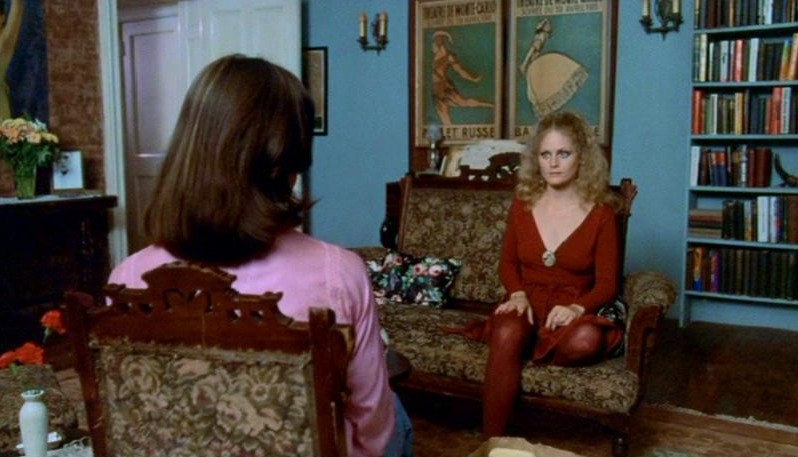

When Gerde leaves the room to make coffee, Sandra stares directly at Alison and starts pawing at her leotard ensnared crotch with a pronounced vigor.


Even though she's probably already made the assumption that they're dancers of some kind, Alison asks them what they do for a living anyway. To her surprise, however, Gerde, without missing a beat, tells her: "We fondle each other." Which lead me to wonder if they had any positions open, 'cause I could really use the money. And I would love to have a career where fondling Beverly D'Angelo on a daily basis was part of my job description.


Speaking of job descriptions, you could view The Sentinel as the tale of one woman's struggle to land her dream job. Now, you're probably thinking to yourself: What could better than being a fashion model? It's true, the life of your average fashion model does seem pretty glamorous. Yet, you have to admit, there isn't much as far as job security goes. Guarding the gateway to hell, on the other hand, is something that always needs doing. So, what you're saying is, The Sentinel is basically a film about the world's creepiest job interview? Yeah, that sounds about right.


I've read that the casting of real life circus performers to play the deformed denizens of hell caused some controversy at the time. However, I found the fact that John Carradine (the blind priest), Jerry Orbach (the commercial director), Nana Visitor (the "girl at end"), Christopher Walken (the detective - he plays Eli Wallach's mostly mute partner), Jeff Goldblum (the photographer), and Tom Berenger (the "man at end") were all basically bit players to be the film's most contentious issue. Of course, the casting director had no idea some of these folks would go on to become household names. But still, it was weird seeing all these talented actors in nothing roles.


That being said, just because you have a nothing role, doesn't mean you can't turn it into something memorable. Don't believe me? Just ask the lovely Diane Stillwell, who plays "Brenner's secretary." Who's Brenner, you ask? It doesn't matter, Diane steals all three scenes she's in simply by employing her Betty Boop meets Lisa De Leeuw-esque charm.


My favourite Diane Stillwell moment comes when Eli Wallach grabs her arm. The, "Hey, bub, you best let go of my arm," look she throws at him mid-arm grab was awesome.


Thursday, November 22, 2012

Fear City (Abel Ferrara, 1984)

If a retired boxer, one who currently runs a talent agency that hires out strippers to the city's strip clubs, meets a psychotic kung-fu master in a dark alley, who would win? Okay, first of all, you have to ask yourself: What's at stake? I mean, the victor has to come away something, or else the contest is meaningless. Well, if the former wins, he gets to continue dating a heroin-addicted Melanie Griffith. As for the latter, he gets the opportunity to finish his literally masterwork. Just curious, what might that masterwork be called? It's called "Fear City," which just happens to the title of my latest cinematic foray into the depths of stripper-adjacent misery. And secondly, how did these two men, who, besides being trained fighters, end up at odds with one another? That's simple, their lifestyles don't mesh. The former boxer makes his living exploiting women for monetary gain, the material artist, on the other hand, while he doesn't exactly "make his living" doing this, enjoys doing bodily harm to the women the former boxer is trying to exploit. You're probably thinking to yourself: An ex-boxer who exploits women (he's basically a pimp with an office) and a deranged weirdo who wields nunchucks after dark (he's basically Joe Spinelli in Maniac, you know, without the mannequin fetish), these are the guys I'm supposed to root for? It's true, they're both scumbags. Nevertheless, I found the film's lack of judgment towards them and the rest of its characters to be its greatest strength. Whoa, hold on there, buddy. Let's not get carried away, shall we? You're right, the film's greatest strength is actually the authentic New York City flavour, specifically, the scenes that take place on 42nd Street, it puts out there on a semi-regular basis. But the fact the lead characters were deeply flawed individuals was very appealing.
 
 
The film, directed by Abel Ferrara (The Driller Killer), might not judge the characters, but that doesn't mean Al Wheeler (Billy Dee Williams), a cynical homicide detective, is going to let them off so easily. You think I'm kidding around? If it's your job to provide the strip clubs that dot the Manhattan landscape with able-bodied strippers, Al Wheeler doesn't like you. If it's your job to provide the strip clubs that dot the Manhattan landscape with able-bodied strippers, and you happen to be of Italian extraction, Al Wheeler straight-up hates your ass.
 
 
Now, I was going to add an Italian slur before the word "ass," but I don't want to appear to complacent about Al Wheeler's intense dislike for Italian-Americans. Having said that, I thought Al Wheeler's anti-Italian stance added yet another layer to this morally complex tale about pimps, strippers, and lowlifes. You see, Al Wheeler, who presents himself as a champion of justice, is basically a reprobate with a badge.
 
 
You'll notice that I called the guys who run the "talent agency" that provide the strippers, or, as they're sometimes referred to, "exotic dancers," for the city's strip clubs as "pimps." The reason for that is I have no idea what to call them. In my mind, if you make money off the exploitation of women, you're a pimp. Not that there's anything wrong with being a pimp. It's just that I don't feel comfortable calling them, oh, let's say, talent agents.
 
 
Looking at the sheer extravagance of the film's opening scene, you might be inclined to think that the producers of Fear City  paid millions of dollars to capture of the seedy charm of 42nd Street in the early 1980s. But I'm sure it didn't cost nothing at all. What I think I'm trying to say is, the director simply has to turn on his or her camera and the energy of the street does the rest. 
 
 
After the opening montage, which included as a dizzying array of garish billboard lights and a steady concourse of thong-ensnared undercarriages gyrating in time to the beat, has finished, the film begins to focus on a blonde stripper named Loretta (Melanie Griffith). Oh, and before you let out a groan. Remember, this is Body Double Melanie Griffith, not Shining Through Melanie Griffith. (The reason I didn't reference Working Girl Melanie Griffith is because I like Working Girl.) Anyway, Loretta, who is wearing full-length blue sequined number with a massive, and I mean, massive, slit down the side, has the audience eating out of her hand.
 
 
Just as we're about to get a close-up shot Loretta pulling down the zipper of her dress, Matt Rossi (Tom Berenger) and Nicky Parzeno (Jack Scalia) arrive at the strip club with much fanfare. If they're not cops, and don't own the joint, what is their connection to this place? I'll answer that question in a minute, Loretta is about to pull on her zipper. Yeah, baby. Great shot, Abel Ferarra; very sleazy. Okay, where was I? The connection. It would seem that Matt and Nicky run the Starlite Talent Agency, the city's premiere stripper emporium. If you need a stripper, these are your guys. Obviously, the owner of this fine establishment, Mike (Michael V. Gazzo), thinks they're his guys, as all his strippers come from their agency. If only he could pay them on time.
 
 
Collecting their weekly commission might be the primary reason they showed up at Mike's club this evening. But judging by the preoccupied look on his face, it's clear Matt's mind is elsewhere. He's thinking about Loretta. You see, the two used to date, and from where I was sitting, they were going at it like bunny rabbits. When their attempt pick up the earnings goes nowhere, Matt decides to pay Loretta a visit in her dressing room. Only problem is, a fellow stripper named Leila (Rae Dawn Chong) has gotten there first; he catches them making out. Leaving in a huff, Matt grouses about what he saw to Nicky, who basically tells him to forget about her.
 
 
It's a good thing Matt has a friend like Nicky he can lean on for support. But more importantly, the actor who plays Nicky, Jack Scalia, also does an excellent job of placating Tom Berenger's non-Italian-ness. I'm serious, if Jack Scalia wasn't in this movie, I wouldn't have bought Tom Berenger as an Italian-American ex-boxer haunted by his past for a second.
 
 
As Loretta is finishing up her performance, and believe me, it's a performance (the crowd reacts to her like she's a disco star), another stripper, Honey (Ola Ray), is dragged into a nearby alleyway by an unknown assailant; who stabs her repeatedly and cuts some of her fingers off.
 
 
Surprisingly, Matt and Nicky are the first to visit her in the hospital. Maybe I was a little harsh on them when I called them pimps. Sure, you could say they're just worried about their property. But they seemed genuinely concerned about her well-being. And I don't know any pimps who can pull off the genuinely concerned routine. In fact, Honey's trauma causes Matt to reflect on an incident that occurred when he was a boxer. In order to help us understand where he's coming from, a flashback sequence is implemented that details the time when Matt killed a fellow boxer in the ring.
 
 
"Get her ass off the bar." And with that line, Billy Dee Williams makes his presence felt in the Fear City universe. Walking into the Metropolitan A Go-Go, a seedy strip club with a wonderfully sleazy atmosphere (much sleazier than Mike's establishment), Billy Dee's Det. Al Wheeler is there to bust Matt's balls and to hurl anti-Italian ethnophaulisms. Getting back to the club for a second. It's true, the waitresses can't seem to get your drink order right (what part of the phrase "no ice" do you not understand?), but the joint is crawling with the right kind of scuzziness. The club's owner, Frank (Joe Santos), a scumbag who loves his new JVC speakers, tries to confront Al Wheeler, who's getting all up it Matt's grill. Big mistake. A visibly annoyed Frank tries to interrupt Al's "conversation" with Matt, to which Al responds, "Am I talking to you, wop?" Frank answers his question with a question of his own, "Then who the hell are you talking to? Al, without missing a beat, says, "I'm not talking to you." It's a great exchange. As it not only does it expose Al's over the top dislike for Italians, but also shows that the people who work in the strip club world don't much care for the cops either.
 
 
The linguistically aware will notice that Al Wheeler has used to words, "wop," "dago," "cesspool," and "greaseball" (a slur he uses twice) during his time at Frank's club. The word "guinea" is uttered, but he unleashes that hateful chestnut later on in the film: "There's nothing I hate more than guineas in Cadillacs."
 
 
With animosity between the victims and the police at at all-time high, it's no wonder the "New York Knifer" (as the local press dub him) seems to have been given free reign to do whatever he pleases. Played by John Foster (though, there's been much discussion about the actual identity of the actor of who plays the killer), the New York  Knifer attacks strippers who look like Rae Dawn Chong (subway platform), Maria Conchita Alonso (apartment), Janet Julian (sidewalk) and Get Crazy's Lori Eastside (the park). If you want to know why the New York Knifer is stabbing his way through the stripper community, look no further than the pages of his manifesto, which, of course, is titled "Fear City." 
 
 
If I had to pinpoint a single moment in Fear City that encapsulates the film's overall appeal, I'd have to say the scene where a heroin-addicted Melanie Griffith enters Metropolitan A Go-Go looking to score some quick cash does the job. Standing in sunglasses in front of a wall of lights that spell out the word "girls" over and over again, Melanie is, in that moment, the poster girl for urban desperation. A state that Abel Fererra manages to capture multiple times over the course the film, but no more so when Melanie is jonesing for a fix. The other thing that made Fear City stand out was the fact that the strippers stopped going to work when the killer started chopping off their heads. I can't tell you how many films of this type that feature clueless characters who continue going about their daily routine despite the fact that there's a killer on the loose. In other words, I appreciated it when they showed the clubs were practically empty.


video uploaded by NiceActorLikeYou 

Friday, July 3, 2009

Eddie and the Cruisers (Martin Davidson, 1983)

He doesn't believe shirts should have sleeves, and she thinks the entirety of one's legs should be unadorned by pesky fabrics such as denim and corduroy, yet somehow they manage to make sweet music together in the wonderfully melodious Eddie and the Cruisers, a raucous look-see into the brief existence of an early 1960s rock and roll band that starts to gel after their charismatic leader and a Rimbaud reading, piano playing songwriter see eye-to-eye in a New Jersey bar. Jumping back and forth between the past and the present, the film chronicles the lives of the surviving members of the short-lived group. Well, actually, its main focus is the post-Cruiser life of Frank "Wordman" Ridgeway (Tom Berenger). Now an English teacher, the one-time rock star finds his musical past making a come back in a big way, as the Eddie and the Cruisers get caught up in the '60s nostalgia wave. Interest in their lost second album "A Season in Hell" and the mystery surrounding death of Eddie (his body was never found) has grabbed the attention of Maggie (the gorgeous Ellen Barkin), a reporter for a music magazine of note. Now, I've never seen an episode of Behind the Music (parodies not included), but the structure of this film by Martin Davidson has all the elements of your classic rise and fall music story: artistic differences (Roxy Music), dead saxophone players (Einstürzende Neubauten), conspiracy theories (Nirvana), the troubled, yet highly innovative follow up record (The Beastie Boys), and inter-band ass fucking (Frankie Goes to Hollywood). However, since the film lacks many of the key ingredients that usually go into making your average rock and roll motion picture (drug abuse and drunken violence being the two big ones), the tuneful enterprise comes across as strangely original.

I also liked how Eddie (Michael Paré) and his band were treated when they perform at a seemingly squarer than square college. This campus sequence is setup as your typical: let's mock a bunch of buttoned-down, unhip cardigan wearers. But it turned out to be the complete opposite in terms of tone and tempo, and of course, proved once and for all that the power of rock, and not to mention, Paré's dreaminess, is incendiary.

The sight of Tom Berenger belting out a rough version of "On the Dark Side" and clutching a book by fancy pants word writer Arthur Rimbaud may have been a bizarre one, but the tough guy definitely shines as the reluctant songwriter. He's got a quiet, restrained quality about him that worked well with the magnetic Paré. It's the kind of non-showy performance that doesn't garner much attention, but it's sort that keeps the film grounded in reality. Though, I must say, I was genuinely surprised by how he was able thwart the leggy assault thrown at him by Ellen Barkin's reporter character. I mean, what kind of man ignores that kind of gam-based onslaught? Truth be told, the fact that Berenger's character wasn't coerced by this shameless display was on the cusp of being impressive.

A crotch moistener if I ever saw one, Michael Paré is freaking hot as Eddie Wilson, the energetic front-man of the film's titular group. Yeah, so what he doesn't do any of his own singing, the amount of sheer manliness Mr. Paré puts forth in Eddie and the Cruisers is off the charts. Again, like Berenger, he doesn't overdo in the histrionics department. This control adds to his overall coolness, and justifies the legend status of character.

Oh, and by not delving too deeply into Eddie's personality, the filmmakers elevate his mystique; a rare case where the less we know, the better.

On the surface, the many scenes that featured the gorgeous Helen Schneider wearing short-shorts seemed like a blatant attempt to curry favour with the smattering of perverts in the audience. Deep down, however, this material-challenged situation turned out to be one of the more brilliant ways to convey on-screen aging that I gave ever seen. You see, most films seem to go overboard when comes to aging characters. This particular film, on the other hand, simply used age appropriate clothing to signify the passage of time: the short-shorts equaling youthfulness and slaphappy whimsicality, while a modest lavender dress and with matching heels signifies practicality mixed with dignity.

Anyway, Helen Schneider reminded me of a cross between Annabella Sciorra and Juliet Landau. In other words, a tantalizing screen presence. Her scene with Michael Paré at the Palace of Depression (a junkyard fortress made out of outmoded automobiles) and the subsequent embrace in front of his turquoise Chevy convertible was my favourite non-musical sequence in the film.

Overly nostalgic for a period of time I'm not really that interested in, and sporting synthesizer-free music from start to finish, Eddie and the Cruisers manages to pull off a minor miracle by making the trials and tribulations of a lame bar band seem compelling, and, dare I say, mildly inspirational.


...