Monday, November 30, 2009

The Slumber Party Massacre (Amy Holden Jones, 1982)

The sexualization of the power drill continues unabated in the aggressively unambiguous Slumber Party Massacre, a stalker-friendly slasher flick from director Amy Holden Jones (Maid to Order) and writer/feminist activist Rita Mae Brown. Unique in that the majority of the people working behind the camera are women, this teens-in-peril tale does little to separate itself from the macho heard. Briskly going about his boring business with the efficiency of a man wielding a larger than normal drill, the killer seems to mainly target young women. Sure, he'll drill an unwanted hole in a man, but only if they happen to interfere with his primary goal, which is to penetrate as many young women as humanly possible. The assailant's weapon of choice, the power drill, might have been the film's only feminine touch. Of course, there have been lots of films that feature madmen who slaughter comely women using implements that can be found in any tool shed, garage, basement or hardware store. But I'm sure it's no coincidence that the common power drill is the one item on the self that is the closest to resembling a man's penis. Moreover, the way the attacker held his tool in this movie was quite sexual. Leading one to believe that this film is an accidental critique of the male libido.

Resting it in the vicinity of his denim-covered crotch when he isn't drilling, the murderer–a recently escaped lunatic named Russ Thorn (the brilliant Michael Villella), who killed five women in 1969–thrusts his drill in a fashion that practically screamed sexual dysfunction. Not to mention, misdirected anger, overcompensation, and homicidal madness.

The number of female persons, and male bystanders, who are at risk of becoming the driller killer's next victim is quite large. At the top of the list is an 18 year-old named Trish (Michelle Michaels), a popular girl who has decided to take full advantage of her parents' absence by inviting a bunch of friends over for a party that may or may not involve slumbering. Though I doubt they will get to do either considering the fact that a massacre is about to commence.

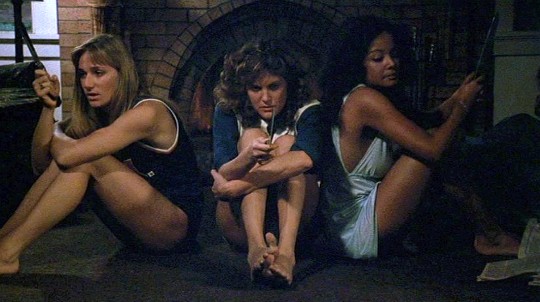
Invited out of pity, but ultimately passing on attending the girly soiree, is Trish's classmate and next-door neighbour Valerie "Val" Bates (Robin Stille); she's decided to stay in and watch over her younger sister, Courtney (Jennifer Myers), an impish gal who looked absolutely delicious in a frightfully cute pair of orange short shorts. (Since it's 1982, skimpy shorts are the film's most prominent piece of clothing.) Anyway, as with most parties of this nature, their feminine solidarity is corrupted by the uninvited presence of two horny teenage boys (Joseph Alan Johnson and David Millbern), a nosy neighbour (the kind that murder snails with meat cleavers), and, oh, get this, a sexually frustrated power tool connoisseur.

While the inquisitive, overly helpful neighbour, and the lustful boys are a bit of a nuance, it's the guy lurking in the garage wielding the massive power drill who should be the main focus of the girl's anxiety. I mean, he's already taken out an attractive telephone repairwoman (Jean Vargas) and a book-forgetting senior (Brinke Stevens), so decimating the contents of an entire slumber party doesn't sound all that far-fetched.

The fact that the movie he's stalking in bares a striking resemblance to John Carpenter's Halloween isn't gonna stop him from getting the bore-based satisfaction is desperately needs. Hell, even the music (a synth-based delight by Ralph Jones), the street the film takes place on, and the camera angles were reminiscent of the film that introduced Michael Myers to the world. That being said, the drilling aspect of the film, while vaguely similar to the drilling that went on in Abel Ferrara's The Driller Killer, was still a pretty fresh concept as far as cinematic works of art that sport deranged killers misusing appliances go.

The alarming sameness of Michelle Michaels and Robin Stille when it came to their appearance and acting styles caused me to look elsewhere for my object of devotion. The short short-heavy basketball sequence (it was the yellow short shorts vs. the blue short shorts) and the obligatory shower scene (my inner pervert appreciated the lingering temperament of some of the bum shots) were quite illuminating when it came to serving up the delicious girl-bouquet that is on display in this movie. But it wasn't until the ladies were in the locker room getting changed that I laid eyes on my fixation.

Playing Diane with a catty glee, the gorgeous Gina Smika Hunter (credited here as Gina Mari) became my favourite slumber party girl the moment she cruelly dismissed Trish's feeler about inviting Val over to her house. What can I say? I love malicious brunettes who act like they're better than everyone else.

Insensitive, somewhat irrational (she doesn't want to invite Valerie to slumber party because "she drinks too much milk), and boasting a steady boyfriend (a tall, sneaky redhead), Diane pretty much insures that her supple body will be getting poked with a large drill in the not-so distant future. Nevertheless, I chose to throw my creepy gaze in her sexy direction. And, yes, she looked amazing in short shorts.

Just because my "creepy gaze" was centered on Gina, doesn't mean that I failed to notice the leggy tour-de-force that was being secretly orchestrated by Debra Deliso (Dr. Caligari and Iced), a statuesque blonde with an elegant physique. Wait a minute, "secretly orchestrated"?!? Are you kidding me? There was nothing secretive about the way her stunning gams playfully jutted out from the bottom of that no-nonsense U.S.A. basketball jersey, which doubles as a sporty yet chic shirt dress (with a generous slit down the sides for maximum leg appeal). On top of that, I liked the manner in which she screamed. What a lot of people tend to forget is how important the act of screaming is when it comes to films like this, and Debra, it should be said, can wail hysterically with the best of them.
The face of the man who attempted to deliver it may be full of holes, but that doesn't mean the pizza he was delivering has become any less edible since his tragic demise. What I'm trying to say is I found that Andree Honore's decision to eat the pizza the a recently drilled pizza boy was clutching in his dead hands to be strangely adorable. I mean, you gotta love the fact that she basically uses his lifeless corpse as an impromptu picnic table. Classic.


...

Friday, November 27, 2009

Mannequin: On the Move (Stewart Raffill, 1991)

A cinematic masterwork that not only manages to comfort me even when I'm not looking in its general direction, but also unclogs my drains, Mannequin: On the Move is magnificence personified. A suicide prevention pamphlet masquerading as an openly lame boy loses girl, girl turns into a doll, doll finds boy as a girl, who is sometimes a doll a thousand years later tale, virtuoso filmmaker Stewart Raffill (The Ice Pirates) and his crack team of writers have thornily fashioned a heartfelt meditation on the power of unconventional love. Unabashedly celebrating inanimate copulation with window dressing and romantic whimsicality in Philadelphia, Pennsylvania, the breezy sequel is the greatest of all the Mannequin sequels; and not just because it's the only Mannequin sequel in existence. No, what goes on in this film will repeatedly put your joy muscles on high alert. There's an accidental brilliance at work here that can't spotted by merely staring at the screen. Uh-uh, what you have to do in order to receive the benefits that this film is offering at a reasonably low-cost is conjure up the purest, gayest part of your inner self, and, most importantly, be willing to let its rejuvenating nectar inundate your aura the same way expired yogurt attacks your central nervous system. Otherwise, what you'll get is the sensation that you have just watched a stupid movie about an average guy who wants to ejaculate his not-so average sperm (it smells like paprika) in the vicinity of a compact blonde who is sometimes a nonliving entity from a made-up part of Bavaria. And believe me, you don't want to feel that sensation.

Now I don't mean to imply that the act of watching Mannequin: On the Move utilizing more established methods, such as sitting and staring, will be an unrewarding experience. On the contrary, there's a lot of quality material floating around this garish cesspool. It just helps that you're a complete and utter moron. The sheer size of my intellect allows me to adapt to different types of entertainment stimuli. Using words that are different than the ones I just used, I was able to view the from the perspective of someone who is borderline mentally challenged. And I don't mean someone who has a learning disability or some kind of fucked up disease, I'm talking about someone who is just plain stupid.

The first thing that struck me as I watched the film from this more slow-witted point-of-view was the manner in which colours, shapes, and sounds were employed. Okay, maybe that's a little too dumb. But it's not that far off from the truth. Actually, Rolf, Egon, and Arnold, the grunting, colourfully attired, musclebound soldiers who are in charge of protecting the mannequin, epitomize all three of those things perfectly. So, yeah, I stand by my initial instinct.

A thespian in every sense of the word, William Ragsdale, not content with having starred in the best vampire movie of the 1980s (Fright Night), the dark-haired rapscallion attempts to dominate the 1990s right out of the gate. I mean, most wait until the middle of the decade to unleash their masterpiece. But William, an iconoclast in every sense of the word, proves that numbers and dates are pretty much meaningless and lashes out with the full fury of his acting arsenal.

It's true, that he has to mostly bounce this fury off a wooden Kristy Swanson and an excessively flamboyant Meshach Taylor. But, as expected, Mr. Ragsdale laughs in the face of this challenge. Carving out a performance that is teeming subtle nuances, William imbues Jason Williamson with a real sense of humanity. A performance that no stiff blonde or preening stereotype can taint.

When referring Kristy Swanson as "wooden" or "stiff," it should be noted that I'm talking about her work as a mannequin, not as a sentient actress; one that looked totally scrumptious in a series of tight leopard print outfits. However, the blankness of Kristy's face does assist her as Jessie, the freshly animated national treasure of the kingdom of Hauptmann-Koenig. In that, her deadpan expression is perfect for absorbing the wonders of the 20th century.

Playing an "enchanted peasant girl" who was turned into a mannequin by a magic necklace a thousand years ago, Miss Swanson does of an excellent job of displaying genuine wonder. Take, for example, her enthusiasm when it came to eating a Philly Cheesesteak and applying lipstick for the very first time, you really get the feeling that she hadn't done these things before.

The same logic could be applied to Julie Foreman as Gail. If the audience doesn't believe her when she offers a customer a complimentary spray of perfume, the film's integrity is in serious jeopardy. Luckily, the attractive Miss Foreman (no relation to Deborah) is up to task at hand: dispensing fragrances to strangers with a competent grace.

Altering our opinion of what it means to be real, Mannequin: On the Move is more than just a film that starts and eventually finishes, it makes a profound statement on what it must be like to be human.


video uploaded by sarafid
...

Monday, November 23, 2009

Rock & Rule (Clive A. Smith, 1983)

In the grand tradition of The Apple and Phantom of the Paradise, the criminally overlooked Rock & Rule presents a dystopian universe where a powerful music label governs society, inclement weather is commonplace (lightning makes for an excellent alternative power source), Faustian deals are made, and the plucky and downtrodden dream of rock and roll stardom. The only difference being it's animated and features talking animals with names like Sleazy, Stretch and Zip. Now, I'm not one to watch "cartoons" on a regular basis, as it's no secret that my main motivation for watching movies is the opportunity to wade in the tepid pool that is partially clothed humanity without getting wet. And I'm definitely not motivated by the desire to be exposed to crudely drawn renderings of raccoons who insist on telling us that littering is unethical. However, I will gladly put aside my reservations (well, aren't you special) for this film directed by Clive A. Smith (co-founder of Nelvana). And, no, not just because its Canadian (the Maple Leaf makes a sly cameo), because it, for the lack of a better term, rocks. Opening with a Café Flesh-style foreword (all that was missing was the expression "nuclear kiss"), this bleak vision of a post-apocalyptic nether region, where everything's either decaying or covered in filth, is a visual and sonic experience like no other. Part Blade Runner, part Liquid Sky (the nightclub scene, anyway), the film wows us with its impressive shots of decrepit skylines, uncompromising depiction of life on gritty streets of Nuke York City, and the wide array of colours that were utilized throughout its economical running time.

I especially liked the use of pink and blue during "My Name Is Mok," and the film's overall cyberpunk aesthetic. I mean, the world may by rundown, but parts of it do glow with a neon sheen.

While the earlier allusion I made to talking animals wasn't that far off the mark, it should be said that these aren't your everyday animals. You see, after the humans eradicate themselves, the world is gradually taken over by the mutated descendants of cats, dogs and rats. This evolved trio are able to live in harmony with one another (I didn't notice a caste system) and pretty much carry on the same way the human race did.

Anyway, a burgeoning rock band comprising of lead guitarist Omar (Paul Le Mat/Robin Zander), keyboard player Angel (Susan Roman), a rhythm section consisting of Toad (Chris Wiggins) and Dizzy (Dan Hennessey) catch the attention of the sinister Mok (Don Francks/Lou Reed), a rock star/record mogul.

Unfortunately, he's not a fan of their music. He does, however, think that Angel's voice is the sound that will finally enable him to unlock the door to a hidden dimension. Unwilling to leave her fellow band members in the lurch, Mok is basically kidnaps Angel and whisks her away to Ohmtown (the power supply in Nuke York City was insufficient) in his massive blimp.

The headstrong Omar, replete with secret feelings for the attractive songstress, is not gonna let this injustice slide. Corralling his buffoonish bandmates, the brooding rocker is willing to attempt multiple rescues if that's what it takes to save the leggy(yeah, that's right, her legs were expertly drawn) Angel and stop Mok and his morally conflicted henchmen before they can carry out their monstrous plan.

Scanning over the soundtrack beforehand, I made a mental note of every song listed. Actually, I should say, I scanned over all the songs except one. Of course, that song would end up being my favourite; that's just the way it is. Heard during the exhilarating nightclub sequence, "Hot Dogs and Sushi" by Melleny Brown percolates with a bratty new wave flair that scratched me where I itch musically. I also loved how the comically proportioned Cindy (Catherine Gallant) dances wildly to it with a suave rat.

Now you could probably understand why I skipped over it when you take a gander at the other names listed om the soundtrack, but that's no excuse; judging songs by their titles is uncool. That being said, I was deeply impressed with "Send Love Through" by Debbie Harry (who provides the voice of the Angel character when she is singing), Lou Reed's "My Name Is Mok," and Earth, Wind & Fire's groovy "Dance, Dance, Dance" (also heard during the club scene).

If you can't tell already, it's obvious that I really enjoyed watching the action at Club 666. So much so, that I even liked the weird laser gun shoot-out that takes place in club's the lobby (a rat turns into a green puddle). On top that, I was strangely jealous over the fact that Toad got to press his nose up against the pulsating largeness of Cindy's animated buttocks.


video uploaded by sipFade2Black
...

Friday, November 20, 2009

The Stuff (Larry Cohen, 1985)

A cautionary tale for all those who enjoy consuming dessert products on a regular basis, The Stuff is a hokey horror farce that manages to skewer everything from mindless consumerism to cold war paranoia, and yet, still be a movie about homicidal yogurt not from outer space. Now I could take the crude route when describing this gooey undertaking – you know, use a lot of vulgar innuendo and tawdry wordplay. But instead, I've decided to take a more classy approach; the kind the whole family can enjoy. Erupting from the fertile mind of writer-director Larry Cohen, this sticky satire is basically: Attack of the Thick White Fluid. Expect, unlike The Blob and other ooze-based creatures, the titular stuff enters the human body without any resistance. Masquerading as a sort of creamy mouthwash, it lures you to inhale its milky load thanks to its sweet taste and the symmetrical hardness of its outer shell. You see, all the intended victim has to do is firmly grab the shaft-like container with one hand, while gingerly manipulating the circular opening with the other, and after a short period of time, the deepness of their throats will be awash with a tasty non-dairy treat. Of course, you'd think that ingesting the pasty fluid orally would somehow hamper its effectiveness – after all, I've never heard of anyone getting in trouble for swallowing goo. However, that what makes the stuff so potent, it prays on your inherent hunger for coagulated seepage.

Mocking advertising, corporate greed, and giving Michael Moriarty (Q: The Winged Serpent) a chance to practice his shoddy Southern accent, this tale of sentient food gone amuck is loaded biting social commentary. The stuff in The Stuff literally comes out of the ground, and since it tastes good, it's immediately rushed into stores nation wide. The speed in which The Stuff becomes a success alarms the members of the ice cream guild. In response, they hire Mo Rutherford (Moriarty), an overconfident industrial saboteur whose job it is to find out what makes "The Stuff" so popular. (The ingredients are mystery.)

This investigation uncovers a conspiracy involving shady FDA employees (Danny Aiello), crazed stockholders (Garrett Morris), an equally crazed army Colonel (Paul Sorvino), and Nicole (Andrea Marcovicci), an attractive ad director; in fact, Nicole is the one who came up with the name and designed the chic tub it comes in.

On the domestic front line of this confectionery invasion is a boy named Jason (Scott Bloom), who, after observing some irregular movement inside his refrigerator at 4AM, is quickly wise to The Stuff's sinister agenda. The enlightened scamp takes this new-found knowledge to the nearest supermarket and proceeds to kick the living gunk out of every tub of The Stuff he can get his little Stuff-hating hands on.

Without a doubt, the finest sequence in the entire film, the sight of a severely pissed off child of 1980s laying waste to an entire dairy section was downright enthralling. I mean, a movie about a deadly wad of mucilaginous paste was the last place I expected to see such an anti-corporate message. Sure, on the surface it seemed like it just your average scene involving a boy busting up the dessert aisle, but there was definitely something cathartic about watching a child, the biggest dupes when it comes to being targeted by advertising, lash out against the system.

The effects in The Stuff were primitive, yet highly effective. Besides, how hard is it to make white sludge appear menacing? The best Stuff usage was when The Stuff attacks Moriarty and the lovely Marcovicci in their motel room. The way it sprayed against the wall had a real spastic flavour to it; reminding me of something I saw in John Carpenter's The Thing, except a tad more whitish.

The ads for The Stuff that played sporadically throughout the film were scary; in that, they were a little too authentic looking. So much so, that I had a serious hankering for some Stuff on several occasions.

Anyway, as far as movies that feature sentient food with world domination on their to-do list, you can't do better than The Stuff, an icky, cinematic treat that comforts the body, mind and soul.


video uploaded by PIMannix
...

Monday, November 16, 2009

Neon Maniacs (Joseph Mangine, 1986)

When the members of Whodini rapped: "The freaks come out at night. (The freaks comes out.) The freaks come out at night!" way back in the day, I always thought their funky declaration to be an unfair vilification of the much maligned increment of time. Sure, most freaks do prefer to come out when it's dark outside (the night air is much more forgiving when it comes to aggravating their contusions), but all they want to do is party and have fun – you know, just like everybody else does. Well, any progress the freak community might have made after that bubbly jam first hit the airwaves is instantly dashed with Neon Maniacs (a.k.a. Evil Dead Warriors), a bizarre and slightly nonsensical horror film about a throng of mindless killers who live under the Golden Gate Bridge in San Francisco, California, U.S.A. Lurching out of their cavernous hideout the second the sun goes down, the act of slaughtering humans in the dark has been turned into an almost blase enterprise. Gingerly going about their bloodthirsty business with a quiet efficiency, they murder for no particular reason. Though, I should say, there was a moment near the end when I thought they wear harvesting the organs of the people they kill. But it turns out that's just the way the Maniac dressed like a doctor (a pre-Djinn Andrew Divoff) likes to dispatch his victims; he removes their organs after rendering them unconscious.

It was this deficiency when it came to explaining things that kept my head spinning throughout this mildly obscure oddity. Of course, I wasn't thinking too hard about the motivation of the Maniacs. (Contemplating the fact that their main weakness was pretty mundane took up the biggest chunk of my brain energy.) But either way, you have to admire the way director Joseph Mangine (cinematographer for Van Nuys Blvd.) managed to create an off-kilter monster flick out of a loose assemblage of hallucinogenic afterthoughts and ideas pulled out of a goblin's ass.

Unanswered questions be damned, this film features a maniac dressed a samurai struggling to walk through a turnstile (don't worry, a fellow maniac who shoots lightning from his fingers helps him out), and a battle of the bands competition as the setting for its climatic showdown. (The best part of the latter being that a nondescript teen turns out to be the leader of sleek new wave outfit called The Outlaws.)

Boasting a strange ambiance from start to finish, Neon Maniacs is like no film I have ever seen before. Everything from the staging of the murders to the dramatic pacing seemed off somehow. Chalk it up to sheer incompetence or a total lack of inexperience on the part of the filmmakers, but whatever they did, it repeatedly ended up being the correct course of action. For example, the decision to use that sinister sounding synthesizer flourish whenever the Maniacs would appear on-screen was the epitome of correctness.

The opening massacre sequence sets the kooky tone of the film early on, as a bunch of snotty teens drunkenly carrying on in a park find themselves inexplicably under attack by an organized group of monsters, freaks and unaffiliated weirdos wielding swords, crossbows and rope (yeah, rope). Since I detested the teens the moment I laid eyes on them (the sight of their de facto leader yelling a derogatory comment toward a group of punks from the relative safety of his moving van rubbed me the wrong way), I didn't feel that bad about their gruesome dismissal.

A teen who survives the park slaughter, the blandly likable Natalie (Leilani Sarelle), Steve (Clyde Hayes), a male classmate who has a thing for Natalie, and a horror aficionado named Paula (Donna Locke) team up to fight the incomprehensible menace. Actually, the younger Paula seems to be the only one genuinely interested in defeating the angry scourge at first.

The fragile Natalie appears indifferent to the mass murder of her peers (the sight of her sunbathing by her pool the next day is what gave me that impression) and Steve's main focus is clearly poontang-related. However, after Natalie and Steve are almost killed by the First Nations, Simian and Samurai maniacs while down in the subway, the two seem more willing to listen to the monster-obsessed ravings of Paula.

Oh, the fact that the Maniacs still want to kill Natalie is the probably closest thing to a conventional plot in this film. You see, the maniacs failed murder Natalie in the park, and spend the rest of the film trying to rectify this mistake. It's not much, but it's something latch on to.

Note to self: If the Neon Maniacs' first attempt to kill you is unsuccessful, don't be surprised when they try again the following night. In other words: Always be prepared.

The liberal use of iridescent slime throughout the film was greatly appreciated, as it is common knowledge that I love iridescent slime. Apparently, it's what the Maniacs bleed when they get cut. Anyway, at first it's just seen languishing in little pools on the ground (the police call it "guck"). But later on it can be seen spraying uncontrollably from the Maniacs when Natalie, Steve and Paula acquire the proper means to kill them.

The constant shots of Donna Locke sitting cross-legged in vampire makeup reminded me of the scene in Starstruck where Jo Kennedy performs "Temper Temper." How you say? Well, the way camera kept showing Ross O'Donovan beaming with pride in the front row was eerily similar to the manner in which Miss Locke beamed while Clyde Hayes (credited here as Alan Hayes) performed his musical number at the battle of the bands competition being held in their school's gym.

And finally, I must say I was quite impressed by Steve's use of the word "environment" when attempting to justify his decision to use public transit on his date with Natalie. Mostly because I didn't know the environment existed back in the mid-80s. In fact, I didn't hear the word uttered once during the 1980s. Yeah, I realize there were trees, plankton and narwhals back then, but I had no idea there were actual people who were calling it the "environment."


video uploaded by EGeeklyFan
...

Friday, November 13, 2009

She's Out of Control (Stan Dragoti, 1989)

The human activity known as "parenting" conjures up images of wholesome families laughing and smiling together in a virtual explosion of happiness. In reality, parenting involves the systematic poisoning your offspring's fertile mind. In other words, feeding them the same nonsense that's been festering in your brain for countless years in the hope that will behave the same way you do. Thus, giving you the impression that your inherent lameness will live on in a place most of us like to call "the not-so distant future." This so-called legacy dilemma just happens to be the one conveniently plaguing the lead parent in Stan Dragoti's She's Out of Control, a mystifyingly straightforward yarn about a single father who not only wants to restrain her teenage daughter's unstoppable journey into womanhood, but also desires the opportunity to suffocate her immaculate vagina with the inconsistent hardness of his erect penis. Now, I realize that the plot description I just typed may sound a little far-fetched, and a tad offensive (you know, from an ethical point of view), but that's what I saw transpiring on-screen. And who am I to pretend otherwise? I mean, every time the father in this movie would look at his daughter screamed incest. (It didn't help that the shots of these looks were played in slow motion.) I'm sure the tone of the character was intended to be that of an overprotective father, but all I saw was a perverted baby boomer trying to keep his eldest daughter all to himself for amoral purposes.

Unintentional or not, the film's creepy flirtations with father-daughter copulation were the least of its problems, as the character of Doug Simpson, the troubled father in question, was loathsome on every level imaginable. A sniveling miscreant , who hasn't had an original thought his entire life, this revolting specimen/father of two works at an oldies radio station (ugh), drives a Jaguar convertible (vomit), and, get this, is dating a woman who looks like Catherine Hicks (lucky bastard).

Portrayed by an extremely dead-eyed Tony Danza, this stressed out dad is shocked to find that his fifteen year-old daughter Katie (Ami Dolenz) has taken a liking to wearing striped stocking socks (the kind that drive depraved men wild) in public, jean jackets adorned with buttons, and competently applied makeup. On top of that, she's gotten contacts, had her braces removed, and begun dating boys other than the neighbour kid she's known since she was six.

Unable to think for himself, the moronic dad does what any gutless turd would do, seeks help from a therapist played by Wallace Shawn. Utilizing the psychiatrist's parental self-help book, Doug befriends his daughter's shock-haired boyfriend Joey (Dana Ashbrook) in an effort to curb his bad boy appeal.

This bit of reverse psychology works surprisingly well. Sure, his Jaguar pays the price, but he has his eldest offspring under control. That is, until Katie dumps him for Timothy (Matthew L. Perry), a smirking nice guy with an unquenchable thirst for clean pussy. It doesn't take a genius to figure out that this asshole is gonna be a lot tougher to contain than the disaffected softie in the leather jacket.

The reason I saw a sexual connection between Tony Danza's inexplicably named Doug Simpson and his daughter Katie wasn't just because of the lingering way he watched her prance about like an untapped oil well in striped tights. Nor was it his intense dedication to keep her torso, face, and feet sperm-free during the Arsenion age. It was the fact that he somehow able to thwart the aggressive advances of Janet, his leggy girlfriend played by the gorgeous Catherine Hicks.

This particular scene was quite the eyeopener, in that, it showed exactly where Doug's head is at. Which is, I'm sorry to say, firmly up the frilly skirt of his own daughter; his unshaven cheeks erotically rubbing up against the smooth layer of adolescent leg skin left exposed by the thigh-high limitations of her store-bought stocking socks.

The only redeeming things about She's Out of Control were Katie's makeover montage, Dana Ashbrook's hair, and Ami Dolenz' risque wardrobe. As you might expect, I was quite taken by Ms. Dolenz' commitment to striped and non-striped legwear. I say, "commitment," because she even wore them underneath her strategically ripped jeans. Anyway, like Samantha Mathis' character in Pump Up the Volume, Katie sheathes her legs in striped stockings in order to rebel against authority. Everything about her father is disgusting (his music, his car, his generational pride, his overall personality), and by wearing stripes on her legs, she is able to convey her frustration in a more subtle manner. A fuck you expressed through irregular hosiery for the ages.

Oh, and I got to give fake credit to the producers for using an obscure Yello song on the soundtrack instead of the usual one they play in most movies. Seriously, to hear "Bostich" from their Solid Pleasure album in a mainstream film is pretty commonplace, but to hear an unknown oddity like "Oh Yeah" (a.k.a. Duffman's theme) was an unexpected treat.


...