Showing posts with label Martha Quinn. Show all posts

Thursday, February 12, 2015

Eddie and the Cruisers II: Eddie Lives! (Jean-Claude Lord, 1989)

Instead of wracking my brain trying to figure out this film's timeline, I should just listen to Eddie Wilson when he says: "It's about the music, man." While I have to admit, that's some top notch advice. I would still like to know when Eddie and the Cruisers II: Eddie Lives! takes place (and, yes, the exclamation mark in the film's title is totally justified). Okay, let me take one more stab at it before switching to a more stimulating topic. The original Eddie and the Cruisers flipped back and forth between 1963 and 1983, and... You know what, who cares? I mean, so what if Michael Paré was only five or six years old in 1963, I totally bought him as a troubled rock star who faked his death in the 1960s and is now working as a construction worker in late 1980s Montreal. I'm telling you, if you flush away all the doubts in your head regarding the film's wonky timeline, you'll discover that this film kinda rocks. Sure, everyone from the original film except for Michael Paré and Matthew Laurance is missing in action. But again, I have to sort of quote Eddie Wilson: "It's about the music, man."


In other words, it's not about the actors, the script, or even the direction, it's about–you got it–the music... man.


The next point I'm about to make is on the cusp of being timeline related, so please bear with me. Don't get me wrong, I dig your music, Eddie Wilson (or should I say, Joe West), I really do, it's just that I'm having trouble buying that people living in late 1980s Montreal would go nuts for Chuck Berry inspired rock 'n' roll, especially when you take in account the city's synth-pop pedigree (Trans-X, Men Without Hats, Rational Youth). 


It reminds me of that heinous scene from the WKRP in Cincinnati episode, "Dr. Fever and Mr. Tide: Part 2" where Dr. Johnny Fever stops acting like his alter ego "Rip Tide," the host of a televised dance music show, and lashes out against his disco-loving overlords. It doesn't seem to matter that the audience is filled with disco fans, he manages to convince them that disco does in fact suck by merely spinning a rock 'n' roll record.


That being said, I'm not a big fan of realism. And besides, why does a film about a made up band have to reflect the tastes of the period? It doesn't. And just like the film's "wonky timeline," I'm going to have to except the fact that Montrealers love their old time rock 'n' roll.


After opening with a guitar lick, the film, directed by Jean-Claude Lord (Visiting Hours), hits us with the classic piano intro to "On the Dark Side," one of the stand out songs from the first chapter in the Eddie Wilson saga.


Now, when sequels allude to the previous film, it usually backfires, as it reminds us of how great the first one was. And by opening with "On the Dark Side," Eddie and the Cruisers II: Eddie Lives! is at risk of having that exact thing happen.


Well, after seeing the film from start to finish, I can safely say that this sequel has nothing to worry about, as not only are the songs (co-written and sung by John Cafferty) just as good as the one's from the first film, I'd go as far as to say that they're better.


I know, that sounds like kooky talk. But I'm serious, "Runnin' Thru the Fire," "A Matter Of Time," "NYC" and "Some Like It Hot" are all barn-burners of the highest order.


What happened to Eddie Wilson (Michael Paré) after his car crashed through a guard rail and landed in the river in 1964? According to this film, he changed his name to Joe West, grew a mustache, moved to Montreal, and became a construction worker; and get this, he's a Habs fan!


Meanwhile, the legend of Eddie Wilson continues to grow around the world. Eddie's record company, Satin Records (the same Satin Records who rejected his sophomore album for being too arty), are still hoping to exploit the reemerged interest in his music.


When Eddie/Joe hears about an Eddie Wilson lookalike contest being held in New York City, he decides to drive down to take a look-see. I know he has a mustache now, but why didn't anyone recognize him? I mean, the real Eddie Wilson is standing in the crowd at an Eddie Wilson lookalike contest.


Either way, you know almost immediately that Satin Records' Dave Pagent (Michael Rhoades) is not to be trusted the second you see that he's rocking a sports coat with a pair of jeans.


Seeing the Eddie Wilson clones lip-sync to his music in black sleeveless t-shirts must have inspired the real Eddie Wilson, because he starts working on songs the second he gets back to Montreal. Obviously a tad burnt out, Eddie decides to unwind by taking in a Habs game with one of his construction worker buddies. It's here that Eddie/Joe meets Diane Armani (Marina Orsini), an artist who wants to paint his portrait.


If you're wondering why Diane, an attractive brunette, would want to paint a portrait of a construction worker she met at a hockey game. It's simple, really, she thinks he has an amazing face. In case you forgot, Eddie/Joe is played by Michael Paré, who is still hunky, still cool and still pleased to meet ya.


Even though Eddie/Joe rejects Diane's offer, she doesn't give up. The following night, Eddie/Joe is at a nightclub. There he buys a drink for  Hilton Overstreet (Anthony Sherwood), the band's sax player. Overhearing their conversation, the band's guitar player, Rick Diesel (Bernie Coulson), challenges Eddie/Joe to put his money where his mouth is (I think I'm using that idiom correctly). Anyway, Eddie/Joe goes on stage and blows everyone away, including Diane, who must have followed him there. Um, stalker much?


After multiple attempts to get Eddie/Joe to join his band, Rick Diesel finally manages to convince him, but only if they hire a new drummer, bass player and keyboardist. These slots are filled by Charlie (Paul Markle), Quinn Quinley (Mark Holmes) and Stewart (David Matheson).


As Eddie/Joe's music career is getting back on track, he also finds time for romance, as Eddie/Joe and Diane become an item. In fact, they become so close, you can drop the whole "Eddie/Joe" charade when referencing them. That's right, Eddie confesses to Diane that he is in fact Eddie Wilson. While I wouldn't say that I got chills when Eddie says, "I'm Eddie Wilson" to Diane, it's still a pretty awesome moment.


The rest of the movie involves Eddie/Joe and Rick Diesel butting heads over the direction they want to the band to take. On the one hand, Eddie/Joe, being a perfectionist, wants the band to practice ("I won't short cut the music!), while Rick Diesel wants the band to start playing gigs. These clashes get a little tiresome after awhile, but the four songs I mentioned earlier manage to smooth things over in the end. Ultimately leading to a highly satisfying conclusion.


Oh, I'd be remiss not to mention that Martha Quinn in this movie. Now, I've said in the past that pointing out Martha Quinn in movies is sort of my thing. But Eddie and the Cruisers II: Eddie Lives! is a little different, in that this is probably Martha Quinn's biggest film role to date.


When she first appears onscreen, as the host of "Rock TV News," I was like, Yay, Martha Quinn! Then, get this, she appears a second time. I thought myself: Two Martha Quinn appearances in the same movie?!? This is crazy. Well, I hope you're sitting down, because Martha Quinn appears onscreen a third time! Three times!!! Can you believe this? Okay, I'm going to go relax.


Wednesday, January 22, 2014

Dead Heat (Mark Goldblatt, 1988)

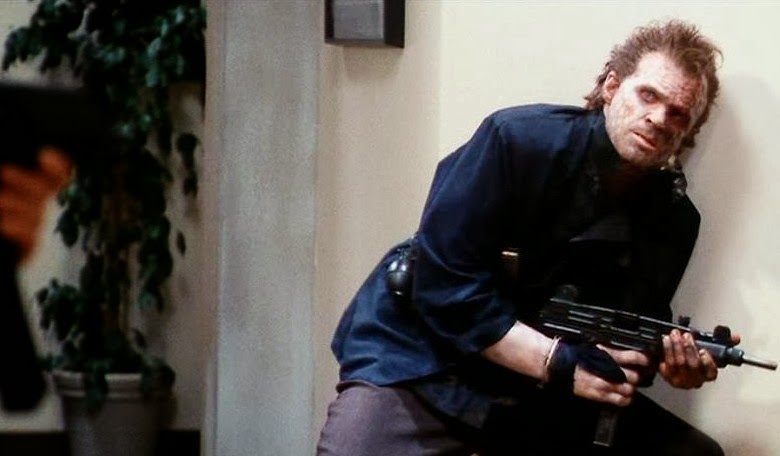
Did someone say, zombies wielding Uzis? What's that, no one said that? Oh, really? Well, someone should say that, and they should say it a lot. Here's a crude theory that just popped into my head. You want to know why the movies from the 1980s rule so hard and why the movies made today...don't rule as much? Uzis. (Uzis?) That's right, Uzis. Movies nowadays seem to be severely lacking when it comes to Uzi usage. I don't know why Uzis stop appearing in movies, but I think most sane people will agree: Uzis make everything better. Movies, TV shows, books, you name it. (Graphic novels?) They would fall under "books," but, yeah, sure, graphic novels. (Are you just going ape shit over Uzis because this particular motion picture was woefully deficient when it came to providing the sleaze?) I'm afraid not. I love Uzis. Always have, always will. And Dead Heat, a, get this, film that stars Joe Piscopo (crazy, I know), has no shortage of Uzis. I won't lie, the simple act of spraying a hail of inaccurate, small caliber bullets in a haphazard fashion never fails to put a smug smirk and/or sly grin on my face. And I like the fact that the person firing an Uzi in a movie rarely ever comes out on top. Every now and then, the so-called hero of the piece will pick up an Uzi from a dead henchmen or bank robber and use it with some degree of success. But for the most part, anyone armed with an Uzi is usually an incompetent boob with one foot already in the grave. There's a brief moment at the end of Scarface where the character of Chi Chi seems to be doing all right, Uzi-wise. However, his Uzi ultimately lets him down in the end. And that's just merely one of the thousands of instances I could sight where an Uzi comes up short during a shootout.


I think the main reason its track record is so uninspired is because most people use them incorrectly. You see, it's meant to be used as a close-quarter weapon (in my non-expert opinion, hallways are the best place to deploy them). But in movies, they're mainly used in wide open spaces. (And that's no good?) No good? You try protecting the expansive compound belonging to, oh, let's say, a brutal drug kingpin, from a musclebound Austrian wielding an M-60 with a bunch of Uzi-toting sycophants with wonky bladders. His 7.62 mm bullets will penetrate the guards like a rusty spike through marmalade, while their puny Uzi-fired bullets will simply bounce off him like weakly foisted flatulence.


I'm putting my Uzi essay on hold. Why? I just remembered a sleazy moment that occurs in this film. (Does it involve Joe Piscopo holding aloft a pair of women's panties?) Actually, it doesn't. But now that I think about, that sounds pretty sleazy. No, the scene I'm referring to occurs when Det. Roger Mortis (Treat Williams) and Det. Doug Bigelow (Joe Piscopo) head over to a pharmaceutical company to investigate a drug that was found in a couple of a dead thieves who were killed during a Melrose Ave. jewelry store robbery. (I don't know, that doesn't sound very sleazy.) I haven't got to the sleazy part yet. (Oops.)


Approaching the detectives with a womanly ease, Randi James (Lindsay Frost), the drug companies attractive P.R. consultant,  is introduced via an upward camera pan that starts at her feet and slowly makes its way to her head.


What we see along the way during this camera pan upward will illuminate and titillate in equal measure.


Her feet have been lovingly poured into a pair of sensible black shoes; perfect for giving tours to nosy detectives.


Black no-nonsense hosiery adorn her shapely legs in a manner that will lift one's spirit; amongst other things.


An unpretentious grey pencil shirt prevents things from getting out of hand, spirit lifting-wise, as it helps cover her crotch, buttocks and upper thighs.


She wears a gold bracelet on her left wrist, which let's everyone know she's not afraid of a little flair.


You'll notice she's wearing a blue name tag with white trim. This allows people to know what her name is at all times. And, as I've already established, it's Randi with an 'i.'


And a sharp grey blazer (buttoned, of course) over top a black t-shirt of some kind completes the ensemble.


(You mentioned something about a couple of dead jewelry store robbers?) Oh, yeah, the crazy thing about them is that Dr. Rebecca Smythers (Clare Kirkconnell) already did an autopsy on them. (So, what you're saying is, they died twice?) Exactly. And Treat Williams and Joe Piscopo, who were responsible for killing the Uzi-wielding jewelry store robbers the second time, are at the pharmaceutical company to find out how a couple of clinical dead guys were able to get up and rob a jewelry store.


I don't know where to squeeze this in, so I'll just slip it in here. And that is, I spotted Martha Quinn as a newscaster during the scene at police headquarters. I'm not sure if everyone is aware of this, but keeping an eye out for Martha Quinn in movies is kind of my thing.


Anyway, the scene where dozens of cops are killed during the shootout with the zombie jewelry store robbers reminded me of Ninja III: The Domination. In that, the ranks of the police force have just been decimated, yet all everyone seems to care about is that Treat Williams and Joe Piscopo broke a few rules and a shitload of regulations. First of all, if they hadn't broke any of your precious "rules and regulations," even more cops would have probably lost their lives. And secondly, relax, man, it's only a movie. Besides, you kind of expect the cops in a buddy cop movie to be chewed out by their superiors, or better yet, a black police captain near retirement, over trivial nonsense. Quirky fun-fact: Dead Heat was written by Terry Black, brother of Shane Black, who wrote Lethal Weapon, the granddaddy of buddy cop movies.


Who's responsible for reanimating the corpses of dead criminals? I wouldn't put it past Darren McGavin, he looks a tad shady. (He looks shady?!? What about Vincent Price? He looks as shady as all get out. Plus, his character's name is "Arthur P. Loudermilk." It practically screams shadiness.)


What Roger really wants to know is, which of these shady fucks pushed the "on switch" while he was trapped inside a decompression chamber while his partner Doug wrestled with a two-faced zombie. It doesn't happen often, but Roger gets to investigate his own murder. With the help of a machine that reanimates dead people, Roger is brought back to life. The catch being, he only has 12 hours to find out who killed him first, as he will eventually melt into a pile of goo. Wait, I think the term they used was "organic stew."


Even though he feels fine, Roger is slowly rotting. (Aren't we all?) Yeah, but Roger knows exactly when he's going to expire, so time of the essence. (If that's the case, why is Roger going to the drugstore?) Um, he's picking up some mulberry wine lipstick. Duh. As you would expect, the lipstick scene leads to some situations of a comedic nature.


Since it's been awhile since we've had any Uzis onscreen, a couple of zombies burst into Randi's house firing Uzis with an inaccurate abandon just as Doug was admiring the cut of Randi's "extra panties" (it never hurts to have extra panties on hand). Out of all the one-liners Joe Piscopo hurls in this movie, my favourite has to be: "Remember the good old days when guns killed people." To which Treat Williams responds: "You're just jealous." (Treat's character is now impervious to bullets).


If you thought fighting Uzi-wielding zombies was hard work, you should try taking on a headless cow carcass, a broiled pig, and an army of duck heads. Of course, Joe Piscopo's advice to Treat Williams as he's about to confront the reanimated cow carcass is to drown it in A-1. Which reminds me, if the A-1 line makes you cringe at all, I don't think you should watch Dead Heat, as the film is peppered with gems like this.


If, however, you dig cheesy one-liners and have a soft spot for Uzi shootouts (the final one is an Uzi lovers dream - even Keye Luke wields one at one point), then you should definitely seek this film out.


Monday, June 13, 2011

Tapeheads (Bill Fishman, 1988)

Firstly, let me start off by saying that I needs to get some chicken and waffles down my gizzard toot sweet. I don't know what it is, but I've recently developed a serious hankering for deep fried bird meat and pancake-based breakfast food. Oh, and if that wasn't kooky enough, I've also acquired this sane yet remarkably specific desire to chew on Mary Crosby's thighs (yeah, that's right, the same Mary Crosby who played the scheming Kristin Shepard on Dallas). I'm no addiction specialist, so I can't possible begin to speculate as to why I've become infected by these peculiar afflictions at this particular point in the space-time continuum. However, I did just finish watching Tapeheads, a wonderfully sardonic film that was recommended to me, oh, let's say, four or five million years ago by an astute linguist whose love for The Swanky Modes is legendary, and if there are two things people takeaway from this curious undertaking that repeatedly shuns the unsubstantiated tenants of antiquated verbosity, it's that fried chicken should always be served with waffles, and that Mary Crosby has succulent thighs. Actually, if you think about it–putting aside the waffles for a minute–it seem the items I'm currently obsessed with are both leg-based meals. Of course, one of the items is consumed for real, while the other, depending on the level of your kink, is consumed figuratively. Either way, you gotta love it when a warped theory comes together in a manner that seems truly organic, but in reality, was completely accidental.

Speaking of which, accidental greatness is what propels a couple of music video directors to great heights in Tapeheads, a film that celebrates, and, at the same time, mocks the music industry with a playful aplomb. Wait a minute, did I just say that it celebrates the music industry? No way, man, if anything, this film, directed by Bill Fishman and produced by Michael Nesmith (Repo Man), mostly mocks it, and it does so in a manner that was spot-on in terms of skewering a subject matter ripe for scornful derision. Record label execs who expect their minions to work for free, mullet-sporting Animotion-wannabes from Sweden, heavy metal fans who abuse the word "awesome" (Zander "there's fuckin' room to move as a fry cook" Schloss plays a headbanger who attends a concert that might feature Menudo, "might" because the marquee says "maybe Menudo"), and right-wing politicians who like to be spanked by women who look like Susan Tyrrell and Courtney Love, all get ridiculed to some agree in this satire of that faraway world that was once dominated by music television.

Nowadays, I can watch any music video I want, whether it be a scintillating slab of italo disco or an ear-destroying piece of post-industrial sex music. My eyes are never more than a click away from immersing themselves inside the warm, Mediterranean embrace of Sabrina Salerno's gyrating cleavage (in most cases I would have said "thighs," but I'm awfully close to using up my thigh quota for this entry, and I'm only on paragraph three). But back in the late '80s, what came in contact with our eyes and ears was strictly regulated by the reticulated forces of unseen lameness. Think about that, a small group, or, in some cases, a single individual, would dictate what kind of music you could and could not listen to. Put another way, while I was bravely enduring music videos by the likes of Honeymoon Suite and Glass Tiger, classic clips by Fancy and Missing Persons were going completely unmolested by my discerning eye and ear areas.

Disturbed by the fact that the cultural landscape is being saturated with shoddily produced music videos, two childhood friends who used to work as security guards decide to start their own video company called "Video Aces." Handling the business end of things is Ivan Alexeev (John Cusack), a real go-getter who seems to be channeling Midge Ure circa Vienna, while the more artistic inclined Josh Tager (Tim Robbins) supplies the creativity. Acquiring a spacious studio loft, free of charge, thanks to Belinda (Katy Boyer), a painter with a penchant for volumizing scrunchies and shooting her canvas with the occasional shotgun blast, Ivan lands the fledgling startup a gig directing a commercial for a local fast food restaurant.

An instant classic the moment Roscoe (King Cotton), the self-assured purveyor of Roscoe's Chicken and Waffles, enters the frame, this particular commercial, despite having a middle-aged white guy rapping at its core, is a smashing success. Sure, Ivan and Josh are paid in chicken and waffles (which apparently are "just pancakes with little squares on 'em"), but sheer scope of the yellow and black world they create, one that features a trio of succinct soul sisters who cross their legs in unison while singing about chicken and waffles, gives them the confidence to seek out bigger clients. Okay, gigs that involve filming séances for recently deceased dogs and the living wills of a bedridden men aren't exactly setting their bank accounts on fire, but it's a start.

What does a music video made on "spec" look like exactly? Well, it kinda looks like three Swedes trying to play synthesizers while having buckets of house paint dumped on their mullet-covered heads (glitter, feathers, fireworks, and water from a fire hose come later). Hired by the dapper Moe Fuzz (Don Cornelius), CEO of Fuzzball Records, the Video Aces land a plum job directing a music video for "Baby Doll," the new single by Cube-Squared (which, in reality, is a DEVO song). Unfortunately, they're working on spec, which means they're not getting paid (not even in chicken and waffles), and, to make matters worse, the video they submitted, according to Mr. Fuzz, "lacks production value" (in other words, no "tits and ass").

Frustrated by their inability to catch a break, the music industry is a fickle hosebeast, Ivan and John decide to apply some "shrewd market penetration," and find themselves at an upscale party hosted by Norman Mart (Clu Gulager), a well-hung presidential hopeful ("I'll put my slab on the yard stick against Gorby any day," he boasts at a press conference) and his garishly dressed wife, Kay Mart (the fabulous Jessica Walter). There to videotape the limbo themed festivities, the Video Aces get unintentionally sucked into a botched blackmail scheme conceived by Nikki Morton (Susan Tyrrell), Norman's excitable mistress (you have to admire a guy who employs Susan Tyrrell as his go-to deviant). The mildly depraved politician (he likes to ride Miss Tyrrell while wearing in a pink tutu) looses track of a videotape containing a previous session of perverted madness, so he orders his team of special agents to find it.

Of course, the tape ends up in the possession of the Video Aces. But more importantly, Ivan gets to massage the exquisite thighs attached to the sultry frame belonging to Samantha Gregory (the gorgeous Mary Crosby), a rock journalist/foxy babe/no-nonsense business woman. Just a second, why is he massaging her thighs? Covered in a maze of thigh-accentuating laces, Samantha's tight-fitting, burgundy dress is being felt up by Ivan because he was looking for a missing contact lens. Duh, squared. Anyway, impressed by his hands on approach to finding her missing contact, his obsession with money and success, and, of course, his overall Midge Ure circa Vienna vibe, Samantha decides that she wants to exploit Ivan for her own personal gain (that's people did in the '80s).

Since new wave and white rap has already been properly mocked, it's time for Tapeheads to ridicule the pomposity of heavy metal, and who better to encapsulate that pomposity than Stiv Bators as the leader a band called The Blender Children. Now you'd think I'd dig this scene because it features scantily clad women jumping into a giant blender, but I actually preferred Xander Berkley's use of the c-word and the fact that one of the blender bimbos asks Tim Robbins to teach her how to read. Oh, and keeping you abreast of Mary Crosby's wardrobe (designed by Elizabeth McBride): she wears a black leather dress with a matching pair of gloves during this sequence.

My favourite scene was the one where Samantha, nunchucks/black leather, and Belinda, duel butterfly knives/red pajamas, engage in a battle for the very soul of the Video Aces. You could say that their fight represented the overall temperament of the 1980s: Samantha, who craves fame and worships material wealth, vs. Belinda, who's all about artistic integrity and neon scrunchies. Well, whatever it represented, nothing beats the sight of Mary Crosby wielding nunchucks.

"You look ravishing and I'd like to chew on your thighs." And with that forthright utterance, John Cusack's Ivan Alexeev jumps to the top of my list of beloved movie characters. Akin to Craig Wasson's panty rescue in Body Double, Ivan's compliment with cannibalistic overtones to Samantha while they dined together at a seafood restaurant was the sanest thing I've heard uttered in a motion picture in a long time. Making matters even more awesome, he also tells her that he wants to flambe her flesh with his tongue. (I'm telling you, I love this guy!) These are the kind of thoughts that rattle around inside my head while I'm riding the subway, and to see someone in a movie actually verbalize these thoughts was mind-blowing.

If things couldn't get any better, after dinner (don't judge me to harshly, but I made an actual laughing sound when John Cusack mistakenly took a sip from a candle), Ivan and Samantha head over to the local cemetery, where he inspects the tightness of her red and black lingerie with a probing beam of light (a.k.a. a flashlight).

Accidentally recording the audio from The Blender Children video shoot onto a tape containing black and white footage of a funeral they shot recently, Ivan and Josh are shocked to learn that their apparent fuck up is being hailed as a work of post modern genius (a critic played by John Fleck declares it so at a viewing party) after it airs on RVTV (the luminous Martha Quinn introduces the clip). And just like that, Video Aces become the darlings of the music video world. However, unlike most inadvertently successful people during the 1980s, Ivan and Josh, well, Josh, anyway, are determined to use their new-found success for good instead of evil. This goodness manifests itself when they decide to help resurrect the career of The Swanky Modes (Sam Moore and Junior Walker), a washed up singing duo that Ivan and Josh have been huge fans of since they were kids.

The plan is to commandeer a Menudo benefit concert (one that is being shown around the world via the miracle that is satellite television) by inserting The Swanky Modes onto the bill instead. Of course, things don't quite work the way Ivan and Josh had originally planned (don't forget, Norman Mart's merry band of incompetent henchman are still looking for the missing videotape), but in the end, after Samantha is finished dodging shrapnel (kudos to Mary Crosby for doing her own stunts), The Swanky Modes take the stage and rock the house with a stirring rendition of "Ordinary Man." The End. Oh, and the word "waffle" is paired with "unlawful" during Roscoe's closing credits rap.


video uploaded by Darryl347
...