Showing posts with label Karen Finley. Show all posts

Wednesday, April 17, 2013

You Killed Me First (Richard Kern, 1985)

I'd like to start off by saying, Happy Canadian Thanksgiving! Of course, on this side of the imaginary line that separates the U.S.A. and Canada, it's simply called "Thanksgiving," but I like to emphasize the holiday's nationalistic component whenever addressing an international audience; hello to my equally imaginary friends in Mordovia and Transnistria. While I realize it's technically not Thanksgiving today, that doesn't mean we can't pretend it is. Besides, I'm not going to let some kitschy wall calendar dictate my behaviour. As everyone knows, I despise award shows (they're vulgar and crass), loathe political speeches (they're filled with insincere nonsense vocalized by non-practicing child molesters), and can't stand calendars (they're...well, they're just plain stupid). Greetings. The reason I'm currently spewing semi-nonsensical vitriol is because I'm trying to reconnect with my inner disaffected teen. Why am I doing this, you ask? Isn't it obvious? Having just watched You Killed Me First from start to finish for the very first time, I would like to get into the mindset of Elizabeth (Lung Leg), or, I should say, "Cassandra," the sullen teen at the centre of this Richard Kern-directed slice/slab/piece of so-called "transgressive cinema." If you thought it was easy for me to identify with Cassandra, you would be wrong. Sure, I saw a lot of myself in Lung Leg's portrayal of alienated youth; hanging around my room all day listening to Wiseblood's "Motorslug," destroying my clothes (i.e. making them "cooler"), and acting like a total brat at the dinner table. But I'm not that person anymore. What's shocking is, how much I identified with Karen Finley as Cassandra's mother. It's true, I mostly envied the fact that David Wojnarowicz (Cassandra's dad) got to plow into Karen Finley's vagina with his penis on a regular basis (whether that "basis" was semi-regular or not is still open to debate). Yet, part of me empathized with her motherly distress. 
 
 
Will wonders never cease? I just remembered the reason I started off on that tangent about Thanksgiving: You Killed Me First begins and ends on Thanksgiving. Yeah, yeah, they don't actually mention the t-word, but it's clear, judging by the large turkey on the table, that it's Thanksgiving. Anyway, what we see in-between these dinner scenes is some of the best teen angst ever to be captured on film.
 
 
Speaking of teen angst, remember how sad you felt when you heard that My So-Called Life had been cancelled? No? Well, I do. And the acerbic tone Richard Kern strikes in this film is the direction I would have liked to have seen My So-Called Life take if Angela Chase and the gang had made it to season two. Come to think of it, My So-Called Life and You Killed Me First already have a lot in common. Just replace Claire Danes' flannel-heavy get-up with a torn Scrapping Foetus Off The Wheel t-shirt, and you're already two-thirds of the way there.
 
 
"Lately, I can't even look at my mother without wanting to stab her repeatedly." ~ Angela Chase

 
Upon further inspection, it would seem that the Thanksgiving dinner from Hell that opens You Killed Me First is the same dinner that closes the film. How do I know this? Well, for one thing, all the actors are wearing the same clothes. And secondly, what occurs after Lung Leg's incoherent rant is an extended flashback sequence that tries to explain how we ended up in this sticky diaphragm of a situation.
 
 
Sitting down for turkey dinner on Thanksgiving, mom (Karen Finley) and dad (David Wojnarowicz) seem worried about their daughter Elizabeth (Lung Leg), who is constantly dropping her fork on the floor. On the other hand, their other daughter, Deborah (Jessica Craig-Martin) is a model of Ronald Reagan-approved docility. Asking her if she washed her hands, Elizabeth answers by saying, "fuck no." I like this chick already. When the topic shifts to Elizabeth's boyfriend, her father starts throwing around words such as "scum" and "slime."
 
 
Just as her mom is about to lose it (the lovely Karen Finley rocks when it comes to losing it at the dinner table), Lung Leg launches into this long tirade. Her piercing eyes filled anger, Lung Leg tells her parents how much she really hates them. As she's about to finish her diatribe, we go back to a, now, I don't want to say "happier time," let's just say, a different time. Doing what most teenage girls did in 1985, Elizabeth plays with her puppets while listening to industrial music.
 
 
It's when Elizabeth introduces her shady-looking boyfriend to her parents that we learn that she wants to, from now on, to be called "Cassandra."
  
  
You gotta love the scene where Karen Finley gives Lung Leg a haircut. Telling Elizabeth that she's giving her "the wind swept look," the kind you see in "Mademoiselle Magazine." She also calls it "the new wave look," and compares it to the hairdo Liza Minnelli sported at the time. Of course, Elizabeth/Cassandra does not approve of this. Which, I have to admit, I didn't quite understand. I mean, who doesn't want to look like Liza Minnelli?!?
 
 
Things continue to go downhill when Karen Finley buys Lung Leg a sweater at the local shopping centre. As expected, Lung Leg is horrified by this shitty garment. But get this, Karen tells her that she bought the cheapest one because she knew that she would probably end up ripping it up and writing "fucker anarchy" all over it. Awesome, eh? I wouldn't have guessed it, but Karen Finley is a cool mom.
 
 
Now, normally this is where I would declare the hair cutting and sweater buying scenes to be my favourite parts of the movie. But I can't do that. Not when there's a scene in the film where Karen Finley wears black stockings while being fucked from behind.
 
 
After a series of scenes that involve praying (Karen Finley in a pink dress), mock gun play (foreshadowing, baby), dead bunny rabbits, puking puppets, and art criticism (Karen Finley in a red dress), we're back where we started, the dinner table.
 
 
Spoiler alert: Shouting, "My name is Cassandra! You killed me first!" Lung Leg shoots Karen Finley in the head. This may sound like hyperbole, but I'm declaring Karen Finley's death in You Killed Me First to be the best movie death in film history. Why? The way she screams (which is complimented by some subtle arterial spray), pauses for a second, then violently rocks back and forth a couple of times (she almost falls out of her chair), before finally expiring was inspirational; I get goosebumps and half-moist just thinking about it. Call me a sick twist, but I could watch Karen Finley's death scene in You Killed Me First over and over again. 


Thursday, March 14, 2013

Party Girl (Daisy von Scherler Mayer, 1995)

It should go without saying, but Parker Posey can come over and reorganize my record collection any time she wants. You call two lousy milk crates a collection? Are you making fun of my records? Not really. I just don't think five Nitzer Ebb 12-inch singles and a handful of Skinny Puppy LPs hardly constitute a "record collection." C'mon, man. I've got more than that. Haven't you heard? I've got the Repo Man soundtrack on vinyl. So, don't be so quick to mock my record collection. What I think I was trying to say was, I don't think you really want Parker Posey to come over and reorganize your records. No, what I think is, you just want to watch Parker Posey crouch in striped pantyhose. You're crazy. Who would watch a movie just to see Parker Posey prance about in an urban setting wearing various types of unorthodox hosiery? Um, you would. Besides, I never said anything about a movie. In fact, I was merely referring to the hypothetical record reorganization scenario you were putting out there. Right. But now that you mention it, is that the real reason you finally decided to watch Party Girl, the film that mixes godmother-goddaughter relationships, hunky falafel stand vendors, house music, high fashion and the Dewey Decimal System? I'll say it again, you would have to be pretty demented to watch a movie for the off chance you might see Parker Posey's lanky, unpretentious legs encased in chromatic tights. You're joking, right? "Off chance"? You know Party Girl is listed as being one of the most nylon-friendly films ever made. Really? I did not know that. Get out of here. You knew. No, I swear. I like Parker Posey and I like house music. In other words, it made perfect sense for me to watch it.     
 
 
You ain't fooling anyone. So why don't you stop kidding yourself, and just admit the truth. I loved how the film, while boasting many terrific club scenes, contained a pro-literacy message. Quit stalling. Okay, fine. I watched Party Girl for the chromatic tights. There, are you happy? Yes. But the more important question is, are you happy? You know what? Ever since I admitted my real motivation for watching Party Girl, I feel as if a giant weight has been lifted off my creamy, and, for the first time since 1989, acne-free shoulders.
 
 
The question that is probably on everyone's mind is: Does Party Girl manage to live up the hosiery hype? You better believe it does. Get this, her legs are covered in nylons in almost every single scene. And this film, co-written and directed by Daisy von Scherler Mayer (now that's a fucking name), isn't one of them flicks that take place over the course of a single night, either. Uh-uh, Parker Posey's gams are sheathed in a seemingly never-ending concourse of chromatic tights.
 
 
Worn throughout a tumultuous year in the life of a fashion-obsessed club kid, one who becomes inexplicably enamoured with the New York Public Library, or, more specifically, the Dewey Decimal System (a.k.a. The Dewey Decimal Classification), and, not to mention, develops a bit of an addiction to falafels drenched in hot sauce, Mary (Parker Posey) wears her tights in a way that can best be described as: defiant femininity.
 
 
If she's not going to let the scourge that is grunge dampen her love of house music, she's certainly not going to let it define the manner in which she displays her legs to the public.
 
 
Yeah, you go, girl! Wear your one of kind Gaultier outfits with pride. And remember, just say no to flannel.
 
 
After being busted for operating an illegal social club (she threw a rave-style party in the stairwell of an apartment building), along with a number of other charges (pirated video cassettes of Paris is Burning and Who's That Girl were found in her possession - they didn't list the actual films that were on the bootlegs, but I bet those two titles were located somewhere in the pile), Mary places a call to her godmother, Judy Lindendorf (Sasha von Scherler), and just like that, she's back on the streets.  
 
 
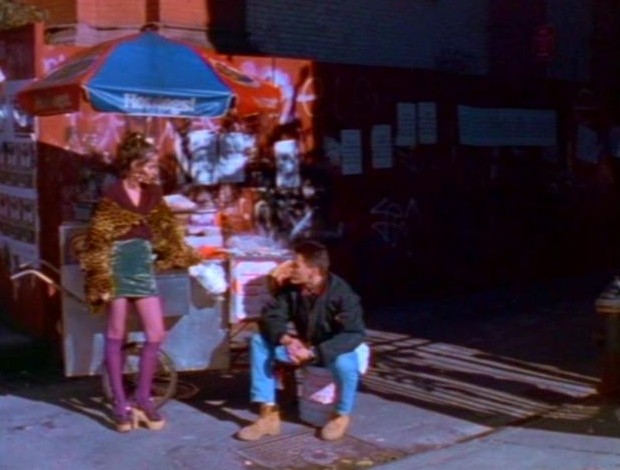
She must have gone home to change, because she is looking fab-u-lous. Not that she didn't look fab-u-lous when she was arrested. I'm just saying, she's looking even more fab-u-lous, if that's humanly possible. What's this? I've just been instructed to stop using hyphens when writing the word "fabulous." Yikes. Tough crowd. Anyway, accompanied by jazzy horn music, Parker Posey saunters down the street (in case it isn't obvious, this film takes place in New York City) in a leopard-print coat, a red skirt, red lacy pantyhose, sunglasses, red gloves, and a pair of purple heels. Carrying a rainbow-coloured purse, Parker stops at a falafel stand and places her usual order: A falafel with hot sauce with a side order of baba ganoush and a seltzer.
 
 
When Mustafa (Omar Townsend), a guy who used to be a teacher in his native Lebanon, finally stops grousing over the fact that a rival falafel vendor is doing brisk business, he starts to flirt with Mary (her gives her some complimentary Turkish delight). And who wouldn't? Flirt, that is. She looks like Parker Posey. If that's not enough. She's wearing lacy red nylons and a leopard-print coat. What more do you want? Just so you know, one of my imaginary gay friends nearly had a heart attack when he first saw Parker strolling down the street in that outfit.
 
 
Somehow convincing her godmother to hire her as a clerk at the library she works, Mary is on the fast track to becoming a responsible adult. Nah, I'm just kidding. She's nowhere near becoming one of those things. I know what you're thinking, why doesn't Mary just get a job as a waitress? Well, for one thing, she's not a waitress ("I'm not a waitress!"). And secondly, no, that's basically it. She seems to take offense whenever the 'w'-word is mentioned, so, it's best not to bring it up again.
 
 
You know how I have imaginary gay friends? Well, like all single gals living in New York City, Mary has many real gay friends. Her main gay friend is Derrick (Anthony DeSando) and he always seems to be there when Mary is either trying on clothes or thinking about trying on clothes. Truth be told, his real purpose is to simply stand there, in a stereotypically gay sort of way, while Parker Posey whines and complains about her life while, of course, she tries on clothes (her wardrobe, by the way, is massive). 
 
 
On top of having a gay friend, Mary also has a non-gay friend named Leo. Played by the adorable Guillermo Diaz, Leo is determined to make it as a DJ, and has enlisted the help of Mary, who, in case I haven't mentioned it yet, has a lot of connections within the city's vibrant club scene. The one's she uses to help Leo are her ex-boyfriend, a bouncer/bartender named Nigel (Liev Schreiber), and Rene (Donna Mitchell), a surly club owner who seems to have a problem with any music that was produced by Teddy Rogers (if you want to spin at her club, you better not play his stuff - it's not really explained why she doesn't want his music played in her club, I'm guessing he done her wrong).
 
 
If you should happen to hear "Lick It (Mood II Swing 'No Afro Sheen' Vocal Mix)" by Karen Finley playing at your local nightclub, try to imagine Rene running towards the DJ booth wielding a broken bottle.
 
 
Using the Myth of Sisyphus as its basis ("it's a metaphor for life...it's famous"), Party Girl is a surprisingly intelligent look at the directionless that afflicted a large number of twentysomethings during the mid-90s. Anchored by an endearingly campy performance by Parker Posey, the film (which could be called the Lady Miss Kier story - she worked as an art gallery receptionist at one point) wonderfully captures New York City during one of its many awkward transitional phases. You could call the film a precursor to the Sex and the City phenomenon that was still years away. But there's no way I'm doing that. The Lady Miss Kier comparison is not only more apt ("Music Selector Is the Soul Reflector" by Deee-Lite is featured on the soundtrack), it's way less lame.
 
 
The only film to have a  Dewey Decimal System montage and a falafel stand montage, Party Girl is the perfect film to watch with a group of your real and imaginary gay friends.
 
 
Oh, and just because I can tell that your dying to know. My favourite Parker Posey ensemble worn during the totally awesome falafel stand montage was outfit #3 (there were a total of five outfits). I thought the purple tights-leather shorts combination made Parker Posey's gams come alive.


Monday, July 4, 2011

Mondo New York (Harvey Keith, 1988)

Following the seductive line of enviable filth that snaked along her sturdy thighs with my finger as the muck made its way down the pale nooks and ashen crannies of her pronounced calve muscles was one of my favourite past times as a withdrawn, easily entertained youth. Held aloft in order that the guy from Foetus could pretend to probe her pulsating pussy with a certain degree of comfort, the sight of Lydia Lunch with her brawny legs in the air was a huge influence on me. Looking directly into the camera as she braced for the pelvic onslaught that was about to be unleashed onto her genital flight deck, it was almost as if Lydia's eyes were speaking directly to me as I stared at her lying spread-eagle on the back of the Stinkfist EP ("The push, the panic, the pain, the poison!"). I like to think that her eyes were trying to tell me something. Perhaps something like, stay true to yourself, and maybe, one day, you'll get to penetrate someone like me. People often never ask me, "What's the deal with your obsession with vulgar words and phrases?" Of course, I wouldn't classify my vocabulary that way at all; it's unrefined language expressed without fear. Anyway, hearing this half-crazed woman one night ranting about wanting to destroy the pathetic cock currently seeking shelter and warmth inside her dangerous vagina, I remember my ears perking up in a manner similar to the way they percolated when I first heard the menacing throb of a Skinny Puppy song on the radio. Well, I soon found out that the half-crazed woman spewing verbal diarrhea all over my tinny speakers was Karen Finley, and just like that, my linguistic outlook was changed forever. Oh, and the reason I used the word "dangerous" to describe Karen's second most popular opening had nothing to do with its appearance or reputation as an unstable structure, but because of the sheer conviction of the voice attached to the vagina led everyone who listened to it to respect its raw power.

What, may I ask, happened when you discovered that not all women are like Lydia Lunch and Karen Finley? Did you, like, freak out and stuff? Since my intense shyness has prevented me from meeting an insane amount of people over the years, it's entirely possible that I haven't met this profane angel yet. However, in a universe replete with delusional pop stars who ripoff Madonna for a living and highly paid morons who paint themselves orange for the amusement of smug mouth-breathers with low self-esteem, I'll admit, my chances of meeting an unhinged performance artist, one who is just waiting to slit my throat with human kindness, are pretty slim. In the meantime, I guess I'll have to settle for watching Mondo New York, the only cinematic travelogue to feature lanky drag queens, BDSM, angry poets, human trafficking, and, of course, Lydia Lunch, who looked absolutely gorgeous laying the groundwork for the weirdness about to unfold for the next eighty or so minutes, and Karen Finley, who spends most of her time doing what she does best: railing against yuppies while covered with animal by-products.

Wait a minute, back up the truck (a truck that is hopefully crammed super-tight with defective dildos), you mean to tell me that there's an actual movie out there that features both Lydia Lunch and Karen Finley?!? You better believe it. Sure, so one of the loquacious lovelies is only in the film for forty-five seconds, but forty-five seconds is still better than nothing. Okay, as far as justifications go for the lack of a person's screentime, that shit is pretty weak. But you have to understand, just because you wanna live in a world where the sight of Lydia Lunch slowing asphyxiating a bound Kate Hudson with the mouth-watering circumference of her unclothed derriere, while Karen Finley tries on irregular pantyhose in the background are daily occurrences, does not mean that world will ever exist. Take the scraps of Lydia and Karen you given and be grateful, you pompous prat.

Conceived by filmmaker Harvey Keith and Night Flight creator Stuart S. Shapiro, the film, a veritable hodgepodge of New York cool, focuses on a wide array of artists, poets, musicians, comedians, perverts, criminals, and drug users at a time when being any one of those things actually meant something. Our guide on this tour, a nameless blonde woman in denim (Shannah Laumeister), quietly walks from one unorthodox venue to another, soaking up the city's unique culture over the course of a single day. Yeah, that's right, she walks quietly. On top of having no name, our guide seems to go unnoticed wherever she ends up, despite the fact she also turns heads (her physical appearance meets many of the rigid standards held by those whose populate the male branch of the heterosexual realm of existence). This anonymous temperament, including the overtones that seem to contradict her anonymity at every turn, gave her presence a decidedly non-judgmental air. Of course, I don't mean to imply that she's some kind of mindless observer, on the contrary, our guide does express her feelings every now and then. But for the most part, she simply absorbs what's put in front of her like she were a sponge or a moldy piece of bread.

You'll notice that I mentioned "New York cool" as supposed to just plain "cool." Well, the reason I did that was to keep to the two distinct types of cool separate from another. My coolness, let's get one thing straight, has never been in doubt, yet the cool that existed in New York City circa, oh, let's say, the ten year period between 1978-1988, will intimidate even the most ardent of cool people. Let me put it this way, there's a reason no one has bothered to make a movie called Mondo Etobicoke.

We open on New York City's world famous skyline, it's around 4 or 5 A.M. in the morning, when, all of a sudden, Lydia Lunch enters the frame, which, by the way, is bathed in mist. She doesn't identify herself as a "Lydia Lunch," but we know who she is. Clutching her jean jacket with a feistier than usual brand of determination, Lydia proceeds to tell us all about the hopes and dreams of the residents of the fair city she stands before. You see, apparently there's this giant garbage pile, and the outcasts, misfits, rejects, loser pervert lunatics, gangsters, pranksters, and outlaws all want to claw their way to the top of it. Standing in their way, however, are bunch of neurotics, psychotics, maniacs, brainiacs, hippies, yippies, yuppies, flunkies, and even monkeys. In other words, it's a war zone out there. The very soul of Mondo New York is up for grabs, and only the most self-absorbed of citizens will be able to claim it.

After Lydia is finished with her prologue, we quickly hook up with our red sneaker-wearing guide. Making her way through a crowd of punks and freaks, our guide enters what looks like a concert venue, positions herself amidst the jaded audience, and watches Phoebe Legere writhe about in an erotic stupor while performing "Marilyn Monroe." Even though the lyrics of the song mostly involve singing the deceased movie star's name over and over again, Phoebe's ebullient stage presence more than makes up for the song's lack of lyrical diversity. Sporting one pink opera glove (dig the black frays, girlfriend), fishnet stockings (which were held up by narrow bands of dark fabric), a gold chain belt, and strumming a guitar with a leopard print strap (yeah, I noticed her guitar strap), Phoebe thrusts and heaves her body across the stage like a raving banshee with rag doll ambitions.

Leaving the concert (I guess she'd seen enough of Phoebe's protruding pubic hair for one day), our guide enters a church-like structure, takes a seat in one of the pews, and watches Joel Coleman, performance artist, Richard Speck fan and all round weird guy, bite the heads off two rodents, utter the phrase "syphilic cunt fossils," and lights the firecracker that was sewn into his poncho. Question: If our guide leaves during a performance (she got up and left just as the rodents were about to lose their heads) does that mean we should go as well? Obviously she wasn't that offended by Joel's mouse abuse, because we see her at his apartment moments later, but it does give the audience something to think about.

Animal lovers will want to avoid the aforementioned rodent decapitation scene, the cockfighting sequence (one rooster is killed by another rooster), and the voodoo ritual (a live chicken has its head bitten off). There's a scene that features the always beguiling Ann Magnuson beating a dead horse with a mattenklopper, but the horse she was pummeling was clearly fake. Fans human cruelty, on the other hand, will want to make sure they catch the scenes that show our intrepid guide peeking through a crack in a wall to catch a glimpse of nipples being clamped and asses being spanked and another where she spies on an illicit gathering where women are being sold at an auction. The former was just your average early morning S&M party (lots of leather and some mild heel sucking), it was the latter scene that threw me for a bit of a loop. At first I thought they selling cheongsams. But then it dawned on me, the body-hugging garments weren't for sale, it was the shapely women poured into them that were being sold.

Tired of whips and chains, our guide heads down some stairs to watch a mentally challenged individual, one who took blithering and twitching in a wheelchair took a whole new level of spasticity, get his special needs penis serviced by Veronica Vera (her womanly epicentre eventually wrapped in cellophane) and Annie Sprinkle (her lumpy, bumpy frame covered in body paint), as Sabine Reithmayer (or it could it been Linda Mac) recites poetry.

It's around noon, and our guide is about to get an earful from a random collection of the Lower East Side's most civic-minded residents. Some yell out the standard "I love New York," while others, like one angry-sounding woman, declare, "I will fight for the Lower East Side." A former East Londoner, who now lives in Alphabet City, thinks the fact that you can now get rap music on compact disc is a sign of the apocalypse. Which, of course, will manifest itself when the yuppies inevitably takeover. Walking into a junkyard, I mean, an outdoor art installation (it's hard to tell the difference sometimes), our guide runs into Joey Arias, who, while as dressed like a flamenco-inspired devil, serenades her with a song called "Fish Out Of Water."

Heading over to the fountain in Washington Square Park, our guide finds a seat on the steps and prepares herself for the ethnic comedy of Charlie Barnett (Miami Vice) and Rick Aviles (Ghost). Announcing that he loves a New York audience, Charlie's routine revolves around jokes based on racial stereotypes (white guys walk this, black guys walk like this), while Rick's schtick was...pretty much the same (black gay guys talk like this, white gay guys talk like this).

Since I've already alluded to the Ann Magnuson scene, which takes place in a pastoral field and has her reciting a poem about prime interest rates to a giant turkey (which, surprisingly, isn't brutally murdered), I'll just mention that I regret not including Ann in my opening bit about Lydia Lunch and Karen Finely. If anyone deserves to be drowned in lavish praise, it's Ann Magnuson, especially a pigtail-sporting Ann Magnuson. Quirky fun-fact: The only audible sound our guide makes in Mondo New York are the screams she lets out as a result of being chased by a carpet beater-wielding Ann Magnuson.

Sandwiched between Joey Arias' elegant, jazzy interpretation of "A Hard Days Night" (I loved the mid-song costume change) and an abridged version of "Hustle With My Muscle" by John Sex ("I'll cram your box 'til it's good and smelly"), is the enchanting Karen Finley, whose scathing spoken word piece was, in my opinion, the moment when the film's overall mission statement (the soulless chunks of yuppie scum who desperately want to corrupt the cultural integrity of our beloved neighbourhood must be stopped) was expressed in a succinct manner. In a work called "I Hate Yellow," Karen strips down to her panties (all good performance art involves nudity), covers her body with egg yolk and glitter, and begins to attack the yuppie mindset ("I'm not gonna let you gang rape me, yuppie!"). The gist of her diatribe is that yuppies and their pastel clothing are the bane of human existence. It's not exactly the most groundbreaking concept, but it's done in a such an entertaining manner, that you're willing look past its apparent banality. I liked the part where she scolds the yuppie's children who are, according to her, a bunch of "nine year-olds who only talk through their computers."

Fully enlightened, and probably hankering a pair of chocolate-covered yuppie balls, our guide observes a crowd slam dancing to "New York New York" by Manitoba's Wild Kingdom ("Everyone's an asshole, everyone's a creep!"), and, like most nights in New York City, ends her evening standing before a bald, long-legged drag queen. Unafraid to drink in every square inch of his fabulous frame, Harvey Keith's camera immortalizes Dean Johnson as he performs "Fuck You" with the Weenies. I can't think of a better way to end Mondo New York than to have a rawboned dandy in shades say "fuck you" to Union Carbide and Mary Tyler Moore, as it sums up the film's anarchistic attitude perfectly.


video uploaded by solidspace a.k.a. soviet
...